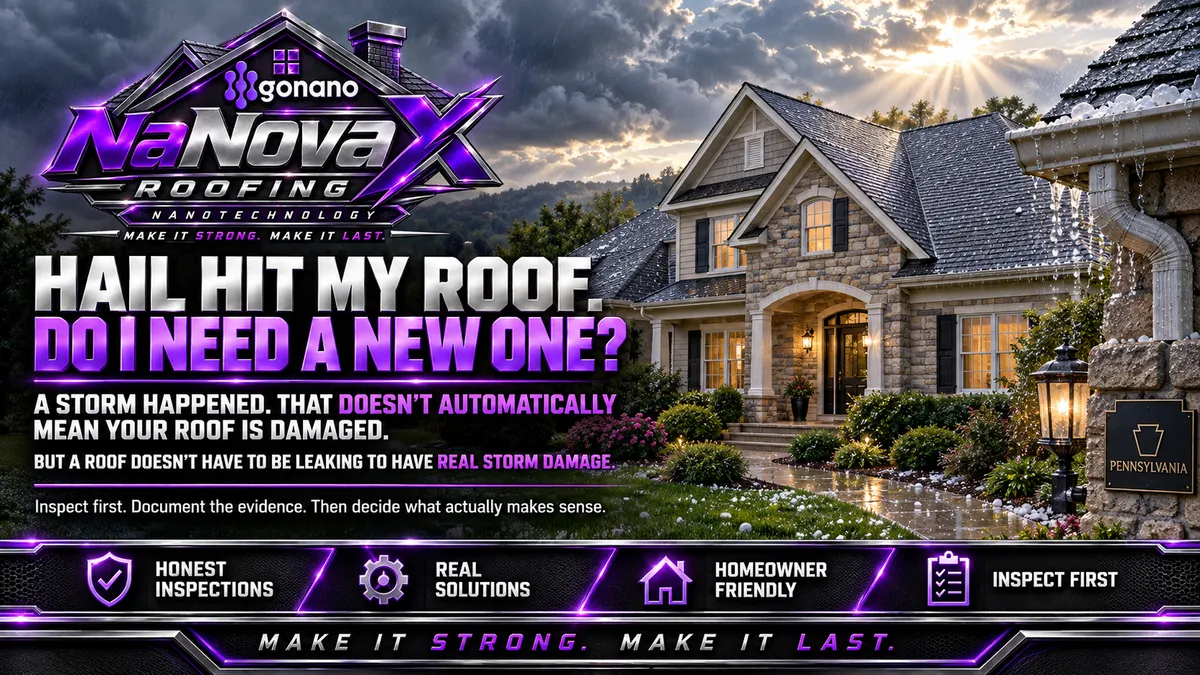
Hail Damage to Your Roof: Repair or Replace? | NaNova X
HAIL HIT MY ROOF. DOES THAT MEAN I NEED A NEW ONE?
How to Tell Hail Damage From Normal Aging, Granule Loss, Shingle Blisters & Other Roof Damage — And When a Pennsylvania Roof May Still Be Worth Saving
By NaNova X Roofing Nanotechnology
GoNano Roof Restoration | Pennsylvania
A hailstorm rolls through Pennsylvania.
The next morning your phone starts ringing.
There's somebody knocking on the door.
Your Facebook feed suddenly has roofing ads everywhere.
And before anybody has really investigated your roof, somebody is already telling you:
"YOU PROBABLY NEED A NEW ROOF."
Maybe you do.
Maybe you don't.
Because here's the first thing I want homeowners to understand:
A HAILSTORM HAPPENED.
THAT DOESN'T AUTOMATICALLY MEAN YOUR ROOF IS DAMAGED.
But the opposite is also true.
YOUR ROOF DOESN'T HAVE TO BE LEAKING TO HAVE REAL HAIL DAMAGE.
Both statements can be true.
That's why I don't want the storm making the decision.
I want the ROOF making the decision.
Inspect it.
Document what actually happened.
Determine whether the shingles were physically damaged.
Look at the rest of the roofing system.
Then decide what the roof actually needs.
--------------------------------------------------
QUICK ANSWER:
DOES HAIL DAMAGE MEAN I NEED A NEW ROOF?
--------------------------------------------------
No.
Not automatically.
Whether a hailstorm results in repair, restoration or roof replacement depends on what actually happened to the roofing system.
An inspection may find:
• No meaningful hail damage
• Cosmetic marks
• Normal age-related granule loss
• Shingle blistering
• Localized storm damage
• Wind damage
• Physically damaged asphalt shingles
• Damaged flashing or roof accessories
• Widespread functional damage
• Other conditions that existed before the storm
The storm date tells us WHEN something may have happened.
It does not automatically tell us WHAT happened.
THE STORM ISN'T THE DIAGNOSIS.
IT'S THE REASON TO INVESTIGATE.
--------------------------------------------------
WHAT DOES HAIL ACTUALLY DO TO ASPHALT SHINGLES?
--------------------------------------------------
Hail isn't all the same.
Different storms can produce hailstones of different:
SIZE.
HARDNESS.
SHAPE.
VELOCITY.
IMPACT ANGLE.
And wind can change how those hailstones interact with a roof.
The Insurance Institute for Business & Home Safety — IBHS — has spent years studying real hail and laboratory hail impacts.
IBHS identifies three primary damage modes when hail impacts asphalt shingles:
DENTING OR DEFORMATION.
GRANULE DISPLACEMENT.
TEARING, CRACKING OR BREACHING OF THE SHINGLE.
That's important.
Because actual hail damage isn't simply:
"I found a round mark."
You need to understand what happened to the material.
SOURCE:
Insurance Institute for Business & Home Safety
Hail & How It Damages Roofs
See live reference link below.
--------------------------------------------------
WHAT CAN HAIL DAMAGE LOOK LIKE ON AN ASPHALT ROOF?
--------------------------------------------------
Depending on the storm and the shingle, an inspection may reveal things such as:
Localized areas where granules were displaced.
Impact marks.
Changes in the shingle surface.
Denting or deformation.
Tears.
Cracks.
Breaches.
Damage to surrounding roofing materials.
But this is exactly where homeowners need to be careful.
Because several completely different roof conditions can LOOK similar.
Especially from the ground.
--------------------------------------------------
HAIL DAMAGE, SHINGLE BLISTERS & NORMAL GRANULE LOSS ARE NOT THE SAME THING.
--------------------------------------------------
This is one of the most important parts of this article.
You've probably seen pictures online showing little round spots on asphalt shingles labeled:
"HAIL DAMAGE."
The problem is that asphalt shingles can develop marks for reasons that have absolutely nothing to do with hail.
Remember our previous NaNova X articles.
Granules naturally loosen and disappear as shingles age.
Shingle blisters can develop.
Foot traffic can damage granules.
Installation damage can occur.
Branches and debris can affect a roof.
Previous repairs can leave marks.
Manufacturing characteristics can create variations.
And hail can create actual impact damage.
Different causes.
Potentially similar-looking evidence.
So:
A ROUND SPOT ISN'T AUTOMATICALLY HAIL DAMAGE.
And granules missing from one little area aren't enough by themselves for me to tell you exactly what happened.
LOOK AT THE ENTIRE PIECE OF EVIDENCE.
--------------------------------------------------
WHAT IS SHINGLE BLISTERING?
--------------------------------------------------
We covered this in our attic and shingle-damage article because homeowners frequently confuse blistering with hail.
A blister is generally a raised area associated with the shingle itself.
Eventually, a blister can open and leave an area where granules are missing.
Now look at that from several feet away.
It can resemble an impact mark.
But:
BLISTERING ≠ HAIL DAMAGE.
That distinction matters even more when an insurance claim is involved.
If we're going to tell a homeowner, roofing contractor or insurance carrier that something happened during a specific storm...
we should have evidence supporting it.
--------------------------------------------------
WHAT ABOUT GRANULE LOSS AFTER A HAILSTORM?
--------------------------------------------------
Hail CAN displace granules.
IBHS specifically includes granule loss among the damage modes it evaluates during asphalt-shingle hail testing.
But granule loss by itself isn't automatically proof that hail caused it.
Why?
Because asphalt shingles lose granules for other reasons too.
AGE.
WEATHERING.
FOOT TRAFFIC.
INSTALLATION.
BIOLOGICAL GROWTH.
PHYSICAL DAMAGE.
NORMAL MATERIAL LOSS.
That's why our Article #3 went so deep into granules.
If there are granules in your gutter the morning after a storm, that deserves investigation.
But the storm doesn't magically erase everything that happened to the roof before yesterday.
--------------------------------------------------
THE QUESTION ISN'T JUST:
"DID HAIL HIT MY HOUSE?"
--------------------------------------------------
The better question is:
WHAT DID THE HAIL ACTUALLY DO TO THE ROOF?
That's a very different question.
Because there's a difference between:
HAIL OCCURRED IN THE AREA.
HAIL HIT THE PROPERTY.
AND
HAIL CAUSED FUNCTIONAL DAMAGE TO THE ROOFING SYSTEM.
Those shouldn't automatically be treated as the same statement.
--------------------------------------------------
LOOK AT MORE THAN THE SHINGLES.
--------------------------------------------------
This is where collateral evidence can become useful.
If we're investigating possible hail damage, we don't have to stare at one shingle and ignore everything else.
Look around.
Depending on the property, hail may also leave evidence on things such as:
METAL FLASHING.
GUTTERS.
DOWNSPOUTS.
VENT CAPS.
OTHER SOFT METALS.
SIDING.
WINDOW SCREENS.
OUTDOOR EQUIPMENT.
VEHICLES.
OR OTHER EXPOSED MATERIALS.
That doesn't mean every dent proves your shingles failed.
It means you're building a larger picture of what the storm did to the property.
Again:
EVIDENCE.
--------------------------------------------------
WHY DOES COLLATERAL DAMAGE MATTER?
--------------------------------------------------
Imagine somebody shows you one questionable mark on a shingle and says:
"Hail destroyed your roof."
Okay.
What else happened?
Was there evidence on exposed metal?
What direction did the storm come from?
What slopes are affected?
Are there repeated impact patterns?
What does the rest of the roof look like?
Is there wind damage too?
Does the roof show ordinary deterioration that predates the storm?
These questions don't automatically eliminate hail damage.
They make the investigation better.
--------------------------------------------------
WIND CAN BE PART OF THE SAME STORM.
--------------------------------------------------
Sometimes homeowners focus so much on hail that they overlook wind.
A severe thunderstorm can bring both.
Now we're looking for potentially different evidence:
LIFTED SHINGLES.
MISSING SHINGLES.
CREASED OR DAMAGED TABS.
BROKEN SEALS.
EDGE DAMAGE.
FLASHING DAMAGE.
TREE OR DEBRIS IMPACT.
And other storm-related conditions.
Again:
One storm.
Potentially several different types of damage.
--------------------------------------------------
A ROOF CAN HAVE REAL STORM DAMAGE WITHOUT LEAKING YET.
--------------------------------------------------
This is important.
Homeowners sometimes tell me:
"My ceiling is dry, so I guess the roof survived."
A dry ceiling is good.
But it doesn't automatically prove every part of the roofing system is undamaged.
Roof coverings exist to shed water.
Physical damage can occur before enough deterioration exists for water to reach the interior.
IBHS notes that severe hail damage can compromise the water-shedding function of a roof covering and create potential pathways for future water entry.
That's why waiting for a ceiling stain isn't the best way to determine whether a storm affected the roof.
SOURCE:
Insurance Institute for Business & Home Safety
Hail & How It Damages Roofs
See live reference link below.
--------------------------------------------------
BUT DON'T TURN EVERY MARK INTO A DISASTER EITHER.
--------------------------------------------------
This is the other side of it.
I don't want homeowners ignoring actual damage.
But I also don't want homeowners terrified because somebody circled 30 questionable marks with chalk.
The objective should be:
DOCUMENT WHAT IS ACTUALLY THERE.
Not:
FIND ENOUGH MARKS TO SELL SOMETHING.
--------------------------------------------------
HOW SHOULD A HAIL-DAMAGE ROOF INSPECTION WORK?
--------------------------------------------------
I want context first.
WHEN DID THE STORM HAPPEN?
WAS HAIL ACTUALLY REPORTED?
WHAT DIRECTION DID IT COME FROM?
WHAT SIZE WAS REPORTED?
WAS THERE STRONG WIND?
HAS THE ROOF BEEN INSPECTED BEFORE?
WHAT CONDITION WAS IT IN BEFORE THE STORM?
ANY PREVIOUS REPAIRS?
ANY PREVIOUS CLAIMS?
ANY KNOWN GRANULE LOSS?
ANY LEAKS?
Then look at the property.
Not just one shingle.
--------------------------------------------------
DOCUMENT BEFORE YOU CHANGE THE EVIDENCE.
--------------------------------------------------
This becomes especially important when insurance may be involved.
Take clear photographs.
Document the roof condition.
Document collateral damage.
Document the affected slopes.
Document repairs that may be necessary to prevent additional damage.
Record the storm date if known.
Keep copies of relevant communication.
The Pennsylvania Insurance Department specifically recommends photographing or recording property damage before cleanup or repairs following severe weather.
It also recommends contacting your insurance company promptly and reviewing your actual policy and deductible.
SOURCE:
Pennsylvania Insurance Department
Natural Disaster Insurance Guide
See live reference link below.
--------------------------------------------------
WHAT DOES HOMEOWNERS INSURANCE COVER FOR HAIL DAMAGE IN PENNSYLVANIA?
--------------------------------------------------
There isn't one answer for every homeowner.
YOUR POLICY CONTROLS.
Pennsylvania homeowners can have differences involving:
COVERAGE.
DEDUCTIBLES.
WIND/HAIL DEDUCTIBLES.
REPLACEMENT COST.
ACTUAL CASH VALUE.
EXCLUSIONS.
ENDORSEMENTS.
ROOF AGE PROVISIONS.
AND CLAIM REQUIREMENTS.
In March 2026, the Pennsylvania Insurance Department specifically reminded homeowners to review whether their policy uses replacement-cost or actual-cash-value coverage and to check for peril-specific wind and hail deductibles.
SOURCE:
Pennsylvania Insurance Department
Homeowners Insurance / Spring Storm Guidance
See live reference link below.
--------------------------------------------------
"DON'T WORRY. INSURANCE WILL BUY YOU A NEW ROOF."
--------------------------------------------------
I would never build a homeowner's decision around that sentence.
A contractor doesn't write your insurance policy.
And a contractor shouldn't promise an insurance outcome they don't control.
If there's storm damage:
DOCUMENT IT.
Understand your policy.
Contact the carrier when appropriate.
Let the evidence and the policy determine what happens next.
--------------------------------------------------
THE INSURANCE COMPANY DOESN'T GET TO CHANGE WHAT HAPPENED TO THE ROOF.
AND NEITHER DOES THE ROOFER.
--------------------------------------------------
That's how I look at it.
The evidence exists whether somebody wants a claim approved or denied.
Our job as roofing professionals is to accurately document what we see.
Not manufacture damage.
Not minimize legitimate damage.
Not exaggerate it.
Just tell the truth about the roof.
--------------------------------------------------
WHAT IF THE INSURANCE COMPANY AND ROOFER DISAGREE?
--------------------------------------------------
Ask questions.
Ask what specifically was observed.
Ask what the carrier's decision is based on.
Ask the contractor to document what they're identifying.
And read the policy.
The Pennsylvania Insurance Department says homeowners can question claim decisions and contact its Consumer Help Center if questions remain.
It also recommends homeowners avoid rushing into settlements before understanding the cost of repairs.
SOURCE:
Pennsylvania Insurance Department
Natural Disaster Insurance Guide
See live reference link below.
--------------------------------------------------
DOES HAIL DAMAGE ALWAYS REQUIRE COMPLETE ROOF REPLACEMENT?
--------------------------------------------------
No.
The extent of the damage matters.
There's a major difference between:
NO FUNCTIONAL DAMAGE.
AN ISOLATED REPAIRABLE CONDITION.
LOCALIZED DAMAGE.
AND
WIDESPREAD DAMAGE ACROSS THE ROOFING SYSTEM.
Shingle type matters.
Repairability matters.
Roof condition matters.
Manufacturer requirements matter.
Availability of matching shingles can matter.
The age and overall condition of the roofing system matter.
Decking matters.
Existing problems matter.
That's why:
HAIL DAMAGE DOESN'T AUTOMATICALLY EQUAL ROOF REPLACEMENT.
But real widespread damage shouldn't be minimized just to avoid replacing a roof either.
--------------------------------------------------
WHAT IF ONLY A FEW SHINGLES ARE DAMAGED?
--------------------------------------------------
Then determine whether legitimate repairs are possible.
Can damaged shingles be replaced correctly?
Is surrounding material still serviceable?
Will performing the repair cause additional damage?
Are matching materials available?
What does the manufacturer require?
What does the rest of the roof look like?
Those answers matter more than somebody yelling:
"REPAIR!"
or:
"REPLACE!"
--------------------------------------------------
WHAT IF THE ROOF WAS ALREADY OLD BEFORE THE STORM?
--------------------------------------------------
Now the investigation becomes even more important.
A 15-year-old roof doesn't magically become brand new the morning before a hailstorm.
There may already be:
GRANULE LOSS.
FADING.
BRITTLENESS.
CURLING.
BLISTERING.
OLD REPAIRS.
VENTILATION ISSUES.
OR OTHER AGE-RELATED CONDITIONS.
That doesn't mean hail couldn't damage it.
It means we need to separate:
PRE-EXISTING CONDITION
from
STORM-RELATED DAMAGE.
Sometimes both exist on the same roof.
--------------------------------------------------
AGE ALONE STILL DOESN'T GET THE FINAL VOTE.
--------------------------------------------------
I've personally seen relatively young asphalt roofs that were already in terrible condition.
I've also seen very old asphalt shingles that were still surprisingly serviceable.
That's why I keep coming back to the same principle:
CONDITION OVER BIRTHDAY.
And after a storm, condition matters even more.
--------------------------------------------------
CAN GONANO FIX EXISTING HAIL DAMAGE?
--------------------------------------------------
This needs to be crystal clear.
GONANO IS NOT A REPAIR FOR PHYSICALLY DAMAGED SHINGLES.
If hail has:
TORN A SHINGLE.
CRACKED IT.
PUNCTURED IT.
BROKEN IT.
OR OTHERWISE CAUSED DAMAGE THAT REQUIRES PHYSICAL REPAIR...
GoNano doesn't magically reverse that damage.
Necessary repairs come first.
GoNano's current hail guidance describes its system as preventive and restorative for structurally sound asphalt shingles, not as a substitute for repairing severe existing hail damage.
SOURCE:
GoNano
Hail Damage to Your Roof: How to Identify It, What Insurance Covers, and the Alternative to Replacement
See live reference link below.
--------------------------------------------------
HAIL DAMAGE AND HAIL RESISTANCE ARE TWO DIFFERENT QUESTIONS.
--------------------------------------------------
This distinction is HUGE.
Question one:
DID HAIL DAMAGE THIS ROOF?
That's an inspection question.
Question two:
CAN A TREATMENT IMPROVE THE IMPACT RESISTANCE OF QUALIFYING ASPHALT SHINGLES?
That's a testing question.
They're not the same.
And this is where GoNano's third-party testing becomes relevant.
--------------------------------------------------
WHAT HAS GONANO ACTUALLY BEEN TESTED FOR?
--------------------------------------------------
GoNano currently reports that its treated asphalt shingles achieved:
UL 2218 CLASS 4 IMPACT RESISTANCE.
That's the highest classification within the UL 2218 impact-resistance standard.
GoNano says its independent testing showed a single application increasing the tested shingles from Class 1 to Class 3 performance and a second application reaching Class 4 performance.
SOURCE:
GoNano
Roof Rejuvenation Compared: Independent Testing vs. Marketing Claims
See live reference link below.
GoNano also lists UL 2218 Class 4 impact testing on its current shingle-technology and science pages.
SOURCE:
GoNano
Shingle Technology
SOURCE:
GoNano
Science
See live reference links below.
--------------------------------------------------
WHAT DOES UL 2218 CLASS 4 ACTUALLY MEAN?
--------------------------------------------------
This is where I want to be accurate.
UL 2218 is a laboratory standard used to evaluate the impact resistance of prepared roof-covering materials.
UL Solutions explains that the test creates four impact-resistance classifications:
CLASS 1
CLASS 2
CLASS 3
CLASS 4
with Class 4 being the highest.
The traditional UL 2218 method uses steel balls dropped from specified heights to create controlled impact energies.
SOURCE:
UL Solutions
UL Solutions & IBHS — Residential Roofing Shingle Impact Testing
See live reference link below.
--------------------------------------------------
DOES CLASS 4 MEAN MY ROOF IS HAIL-PROOF?
--------------------------------------------------
NO.
And anybody selling impact resistance needs to understand that distinction.
CLASS 4 DOES NOT MEAN:
NO HAILSTORM CAN DAMAGE YOUR ROOF.
Real hail is more complicated than a laboratory steel ball.
Natural hail varies in:
HARDNESS.
SIZE.
SHAPE.
DENSITY.
VELOCITY.
IMPACT ANGLE.
AND WIND CONDITIONS.
IBHS developed its newer hail-testing protocol specifically because it wanted testing that better represented natural hailstones and evaluated additional damage modes such as denting and granule loss.
UL Solutions itself explains that traditional UL 2218 focuses primarily on physical breach, while the IBHS protocol also evaluates surface damage such as denting and granule loss.
SOURCE:
UL Solutions
UL Solutions & IBHS Drive Trust in Residential Roofing Shingles
SOURCE:
IBHS
Impact Resistance Test Protocol for Asphalt Shingles
See live reference links below.
--------------------------------------------------
IMPACT RESISTANT DOESN'T MEAN IMPACT IMPOSSIBLE.
--------------------------------------------------
That's the wording I want homeowners to remember.
A better-performing roofing material may reduce vulnerability.
It doesn't make the laws of physics disappear.
If Mother Nature throws something hard enough at anything...
damage is possible.
So I wouldn't market GoNano by saying:
"YOUR ROOF IS NOW HAIL-PROOF."
That's not what Class 4 means.
What we CAN say is:
GoNano reports that treated shingles achieved Class 4 performance under UL 2218 impact testing.
That's a real, specific statement.
And it's much stronger than making claims we can't defend.
--------------------------------------------------
WHY IS THE GONANO TESTING INTERESTING?
--------------------------------------------------
Because we're not talking about installing a completely new Class 4 shingle.
We're talking about testing performed on asphalt shingles after treatment.
That's what makes the result worth discussing.
But again...
testing doesn't give us permission to ignore the condition of an actual roof.
If the roof is already physically destroyed by hail:
REPAIR OR REPLACE WHAT NEEDS REPAIRED OR REPLACED.
Testing doesn't erase existing damage.
--------------------------------------------------
WHAT IF HAIL HIT MY ROOF BUT IT'S STILL STRUCTURALLY SOUND?
--------------------------------------------------
Now we evaluate what actually happened.
Maybe the inspection shows no meaningful damage.
Maybe there are localized repairable issues.
Maybe physically damaged shingles can be replaced.
Maybe the decking is solid.
Maybe the remaining shingles are aging but still viable.
Now the question becomes:
IS THE EXISTING ROOF STILL WORTH PRESERVING?
That's where GoNano roof restoration may become part of the conversation.
--------------------------------------------------
REPAIR FIRST.
RESTORATION SECOND.
--------------------------------------------------
Same principle as our leak article.
Same principle as our nail-pop article.
Same principle as our sunken-decking article.
If something is damaged:
FIX IT.
Then evaluate the remaining roofing system.
GoNano's current roof-candidate guidance says structurally sound asphalt-shingle roofs can qualify for Structural Roof Rejuvenation, while widespread leaks, badly deteriorated shingles, rotted decking and structural sagging generally disqualify a roof.
SOURCE:
GoNano
Is Your Roof a Candidate for Roof Rejuvenation?
See live reference link below.
--------------------------------------------------
WHAT IS GONANO ROOF RESTORATION?
--------------------------------------------------
GoNano Structural Roof Rejuvenation is designed for qualifying asphalt-shingle roofs that are aging but still structurally sound.
GoNano describes the technology as working within the asphalt shingle rather than functioning like a conventional surface coating.
For the homeowner, the important part is simpler:
THIS IS ABOUT PRESERVING A ROOF THAT IS STILL WORTH PRESERVING.
Not disguising failure.
Not covering up hail damage.
Not replacing broken shingles with chemistry.
SOURCE:
GoNano
What Is Structural Roof Rejuvenation?
See live reference link below.
--------------------------------------------------
SHOULD I APPLY GONANO IMMEDIATELY AFTER A HAILSTORM?
--------------------------------------------------
Not before you know what happened.
FIRST INSPECT.
If storm damage exists, document it.
Address the insurance process when appropriate.
Repair physical defects.
Determine whether the roof remains structurally sound.
THEN determine whether GoNano roof restoration makes sense.
You don't want to alter evidence before a potential insurance inspection.
And you don't restore something before you've determined whether it actually needs repaired.
--------------------------------------------------
WHAT ABOUT A NEWER ROOF THAT WASN'T DAMAGED?
--------------------------------------------------
That's a different conversation.
If the roof survived the storm and is still in good condition, prevention and future impact resistance may become worth discussing.
GoNano currently positions NuRoof Fortify for newer asphalt-shingle roofs and reports UL 2218 Class 4 impact-resistance testing among its performance credentials.
That doesn't mean the next hailstorm can't damage the roof.
It means there's actual laboratory impact-performance data behind the conversation.
SOURCE:
GoNano
Shingle Technology
See live reference link below.
--------------------------------------------------
SHOULD I FILE AN INSURANCE CLAIM EVERY TIME IT HAILS?
--------------------------------------------------
That's ultimately a decision between the homeowner and their insurance carrier based on the circumstances and policy.
What I can tell you is this:
DON'T INVENT DAMAGE.
DON'T IGNORE DAMAGE.
DOCUMENT WHAT ACTUALLY HAPPENED.
If legitimate storm damage exists and you're considering a claim, review your policy and communicate with your carrier.
The Pennsylvania Insurance Department recommends contacting the insurer promptly following storm damage and documenting damage before cleanup or permanent repairs.
SOURCE:
Pennsylvania Insurance Department
Natural Disaster Insurance Guide
See live reference link below.
--------------------------------------------------
BE CAREFUL AFTER MAJOR STORMS.
--------------------------------------------------
Storms bring legitimate roofing professionals out to help homeowners.
They can also bring people whose entire business model is getting a signature before the homeowner understands what's happening.
The Pennsylvania Insurance Department specifically warns homeowners to be cautious with door-to-door contractors following natural disasters.
It recommends checking references, confirming that contractors are registered and insured, getting work in writing and not signing incomplete paperwork.
That's good advice.
SOURCE:
Pennsylvania Insurance Department
Natural Disaster Insurance Guide
See live reference link below.
--------------------------------------------------
WHAT SHOULD I DO AFTER HAIL HITS MY PENNSYLVANIA HOME?
--------------------------------------------------
You don't need to climb onto the roof yourself.
Start safely.
Look for obvious damage around the property.
Take photographs if something looks damaged.
Record the date of the storm.
Look at gutters, downspouts, siding and other visible surfaces from safe locations.
If you're concerned about the roof, have it professionally inspected.
Then ask the contractor to SHOW YOU what they're finding.
Not just tell you:
"Trust me."
If they believe something is hail damage:
SHOW THE EVIDENCE.
If they believe the roof needs replaced:
EXPLAIN WHY.
If they believe it's repairable:
EXPLAIN WHY.
If they believe nothing needs done:
That's an acceptable answer too.
--------------------------------------------------
HOMEOWNER QUESTIONS ABOUT HAIL DAMAGE
--------------------------------------------------
DOES HAIL DAMAGE ALWAYS MEAN I NEED A NEW ROOF?
No.
The severity and extent of actual damage matter. Some roofs may have no meaningful damage, some may have localized repairable damage, and others may sustain widespread damage that justifies replacement.
WHAT DOES HAIL DAMAGE LOOK LIKE ON ASPHALT SHINGLES?
Hail can cause deformation, granule displacement, tears, cracks or breaches. However, some age-related or manufacturing conditions can look similar, so appearance alone should be evaluated in context.
IS GRANULE LOSS PROOF OF HAIL DAMAGE?
No.
Hail can displace granules, but asphalt shingles can also lose granules through aging, weathering, foot traffic and other causes.
CAN SHINGLE BLISTERS LOOK LIKE HAIL DAMAGE?
Yes.
Opened blisters can create areas of granule loss that may resemble impact marks. The cause needs to be investigated.
CAN MY ROOF HAVE HAIL DAMAGE WITHOUT LEAKING?
Yes.
A roof can sustain physical damage without immediately producing an interior leak.
SHOULD I LOOK FOR DAMAGE TO GUTTERS AND METAL?
Collateral evidence around the property can help an inspector understand what a storm may have done, although dents or marks on other materials do not automatically prove the shingles were functionally damaged.
CAN WIND AND HAIL DAMAGE HAPPEN DURING THE SAME STORM?
Yes.
A severe storm can expose a roof to both hail impact and wind forces, creating different types of damage.
DOES HOMEOWNERS INSURANCE COVER HAIL DAMAGE IN PENNSYLVANIA?
Coverage depends on the individual policy.
Homeowners should review their coverage, deductible, wind/hail provisions and whether the policy uses replacement-cost or actual-cash-value settlement terms.
CAN GONANO REPAIR SHINGLES ALREADY BROKEN BY HAIL?
No.
Physical shingle damage that requires repair should be corrected first.
HAS GONANO BEEN TESTED FOR IMPACT RESISTANCE?
Yes.
GoNano currently reports that treated shingles achieved UL 2218 Class 4 performance in independent impact testing.
WHAT IS UL 2218 CLASS 4?
UL 2218 is a laboratory impact-resistance standard for prepared roof-covering materials.
Class 4 is the highest of the four classifications in that standard.
DOES UL 2218 CLASS 4 MEAN HAIL-PROOF?
No.
Class 4 demonstrates performance under a defined laboratory impact test.
Natural hailstorms vary considerably, and no responsible roofing professional should describe a Class 4 result as proof that a roof can never be damaged by hail.
CAN GONANO BE USED AFTER HAIL DAMAGE IS REPAIRED?
Potentially.
If necessary repairs are completed and the remaining asphalt-shingle roofing system is structurally sound and qualifies for treatment, GoNano roof restoration may be an option.
SHOULD I HAVE MY ROOF INSPECTED AFTER A HAILSTORM?
If your property experienced significant hail or you see signs of possible storm damage, an inspection can help determine whether anything actually happened to the roofing system.
--------------------------------------------------
THE NANOVA X APPROACH
--------------------------------------------------
A storm shouldn't automatically turn into a roof replacement.
And protecting an existing roof shouldn't become an excuse to ignore legitimate storm damage either.
Start with the roof.
Inspect it.
Document what happened.
Separate hail damage from ordinary aging or unrelated defects.
Repair physical damage when repairs make sense.
Replace the roof when replacement is actually necessary.
And when the asphalt roofing system remains structurally sound and worth preserving, evaluate whether GoNano roof restoration can help protect it going forward.
That's the decision we're trying to make.
Not:
"How do we sell something because it hailed?"
But:
"WHAT DOES THIS ROOF ACTUALLY NEED?"
For Pennsylvania homeowners dealing with hail damage, storm damage, granule loss, suspected shingle impact damage or questions about GoNano roof restoration, the answer should begin with an inspection.
Condition first.
Evidence first.
Then the solution.
NaNova X Roofing Nanotechnology
Pennsylvania
MAKE IT STRONG.
MAKE IT LAST.
--------------------------------------------------
SOURCES & FURTHER READING
--------------------------------------------------
Insurance Institute for Business & Home Safety (IBHS)
Hail & How It Damages Roofs
Insurance Institute for Business & Home Safety (IBHS)
Impact Resistance Test Protocol for Asphalt Shingles
UL Solutions
UL Solutions & IBHS Drive Trust in Residential Roofing Shingles
Pennsylvania Insurance Department
Natural Disaster Insurance Guide
Pennsylvania Insurance Department
2026 Pennsylvania Homeowners Insurance / Spring Storm Guidance
GoNano
Hail Damage to Your Roof
GoNano
Roof Rejuvenation Compared: Independent Testing vs. Marketing Claims
GoNano
Shingle Technology
GoNano
Science
GoNano
Is Your Roof a Candidate for Roof Restoration?
GoNano
What Is Structural Roof Restoration?