What Did a Ph.D. Researcher Discover About GoNano? | NaNova X
WHAT DID A PH.D. RESEARCHER ACTUALLY FIND WHEN HE STUDIED GONANO?
There are a lot of claims in roofing.
I've heard them.
You've probably heard them.
"This will make your roof last longer."
"This will protect your shingles."
"This technology changes everything."
That's easy to say.
But when I started looking seriously at GoNano, I wanted something different.
I wanted to know:
WHAT DOES SOMEBODY WHO ACTUALLY STUDIES THIS STUFF SAY?
Not a salesperson.
Not a roofing contractor.
Not somebody standing at a kitchen table trying to sell a homeowner something.
I wanted to know whether an actual scientist had looked at GoNano-treated asphalt shingles and compared them to untreated asphalt shingles.
The answer is yes.
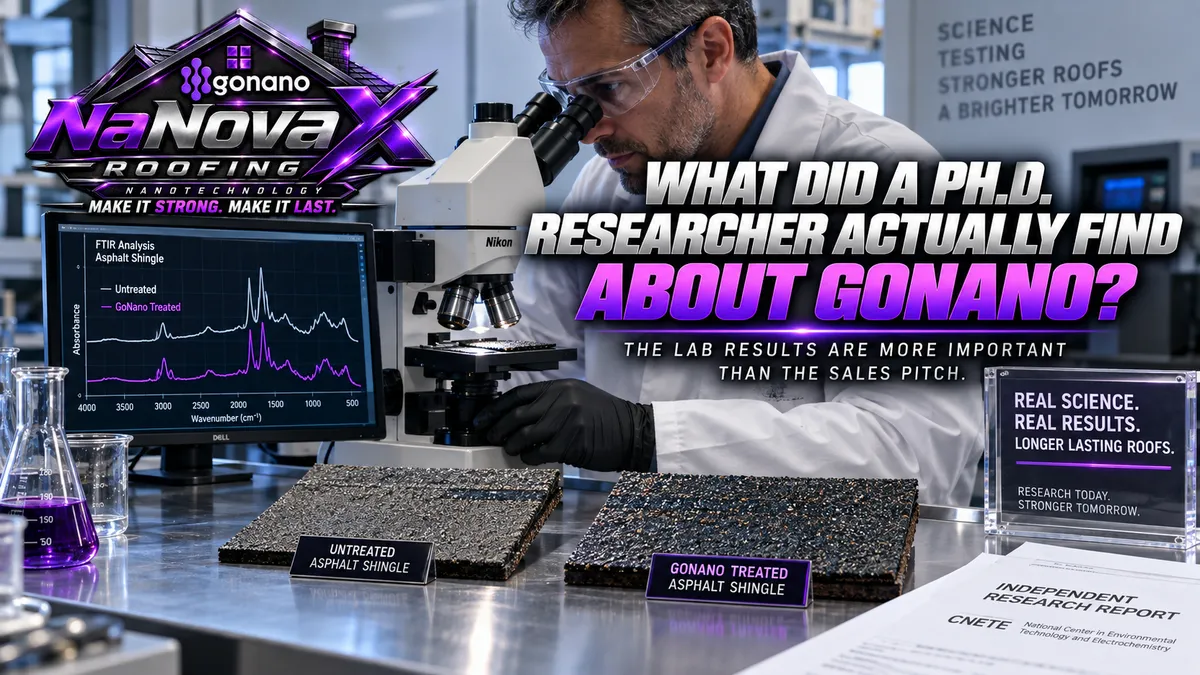
One of the people who evaluated GoNano's technology was Antonio Avalos Ramirez, Ph.D., Eng., an Environmental Technology Researcher with CNETE — the National Center in Environmental Technology and Electrochemistry in Canada.
And this is where the GoNano conversation gets a lot more interesting.
Because CNETE didn't simply look at a GoNano brochure.
They analyzed the material.
They compared treated asphalt roofing products to untreated asphalt roofing products.
They used laboratory equipment capable of identifying changes in the chemical makeup of those materials.
Then they documented what they found.
That's what I want to talk about in this article.
Not hype.
Not roofing salesmanship.
The actual findings.
WHO IS ANTONIO AVALOS RAMIREZ, PH.D.?
Antonio Avalos Ramirez is identified in GoNano's published scientific material as:
Antonio Avalos Ramirez, Ph.D., Eng.
Environmental Technology Researcher
National Center in Environmental Technology and Electrochemistry — CNETE
He's also a published scientific researcher.
His name appears on peer-reviewed scientific research involving environmental technologies, bioprocesses and chemical analysis.
That's important to me.
Because when somebody with a Ph.D. and an engineering/research background studies a roofing technology, I'm going to pay more attention to that than I am to a marketing slogan.
That doesn't mean you blindly believe everything because somebody has letters after their name.
Science doesn't work that way either.
You look at:
What was tested?
How was it tested?
What was compared?
What did the equipment detect?
What did the researcher conclude?
And what can we reasonably say from those results?
That is exactly how I think homeowners should look at GoNano.
WHAT DID CNETE ACTUALLY TEST?
GoNano asked CNETE to analyze modifications occurring in asphalt shingles and SBS elastomeric roofing membranes after treatment with the GoNano roofing protection product.
CNETE received both treated and untreated asphalt roofing materials.
That matters.
Because you need something to compare against.
For the asphalt shingles, the researchers had an untreated sample and a sample treated with GoNano.
The same type of comparison was performed with SBS membrane material.
CNETE also received the GoNano product itself so the researchers could characterize what was in the solution.
The laboratory then analyzed the materials using something called:
FOURIER TRANSFORM INFRARED SPECTROSCOPY.
Or FTIR.
That sounds complicated.
The basic idea isn't.
FTIR allows researchers to look at the chemical fingerprints of materials.
Different chemical bonds interact with infrared energy in different ways.
The equipment can detect those differences.
So instead of simply looking at a GoNano-treated shingle and saying:
"Yep, looks different."
They could actually analyze whether the chemical characteristics of the treated material were different from the untreated material.
And according to the CNETE report, they were.
THEY FOUND ORGANOSILICON COMPOUNDS IN THE GONANO-TREATED SHINGLE
This is one of the findings that caught my attention.
When CNETE analyzed the untreated asphalt shingle, they identified chemical groups normally associated with the organic components of the asphalt roofing material.
After the asphalt shingle was treated with GoNano, the researchers reported the appearance of functional groups associated with organosilicon compounds.
In plain English:
The laboratory could detect chemical characteristics associated with the GoNano treatment in the treated asphalt material that weren't showing up the same way in the untreated shingle.
That's a lot different from saying:
"We sprayed something on the roof and water beaded."
Water beading is something a homeowner can see.
Chemical modification is something a laboratory has to measure.
That distinction matters.
WHAT DID THE PH.D. RESEARCHER SAY ABOUT GONANO?
Antonio Avalos Ramirez made a statement that appears throughout GoNano's scientific documentation.
He reported that asphalt shingles treated with GoNano showed improvements over untreated shingles, including improvement in anti-aging properties and durability.
That's a strong statement.
But what's even more important than the statement is what's sitting behind it.
The CNETE technical report provides details about the chemical analysis and explains WHY the researchers reached those conclusions.
That's where I think homeowners should pay attention.
CNETE FOUND NEW CHEMICAL BONDS
According to the research report, the nanosilica treatment wasn't simply detected as loose material sitting there.
The researchers reported that the nanosilica and the coupling agents used in the GoNano system produced new chemical bonds in the asphalt roofing material.
The report describes the stability of those new bonds as evidence of a strong reaction with the asphalt products.
Think about what that means.
One of the biggest distinctions GoNano makes is that its technology isn't supposed to operate like a traditional coating that simply creates a film on top of the roof.
GoNano describes its Structural Roof Rejuvenation technology as interacting with and reinforcing the material itself.
The CNETE analysis gives us something measurable behind that explanation.
The laboratory detected chemical differences.
It identified silicon-containing functional groups.
And the researchers reported new chemical bonding associated with the nanosilica treatment.
That's much more interesting to me than simply saying:
"Nanotechnology is cool."
SHOW ME WHAT IT DOES TO THE MATERIAL.
THE RESEARCHERS REPORTED INCREASED FLEXIBILITY
Asphalt shingles don't stay exactly the same forever.
Over time, exposure to heat, sunlight, oxygen and weather can contribute to the aging of the asphalt.
As the material ages, shingles can become harder and more brittle.
Eventually you may begin seeing cracking, curling, granule loss or other deterioration.
Flexibility matters.
According to the CNETE report, adding the nanosilica treatment increased and regenerated flexibility in the tested asphalt roofing products.
The researchers connected this improvement to the creation of new chemical bonds.
That matters when we're talking about GoNano roof restoration.
Because we're not simply trying to make an old roof shiny.
We're trying to preserve the physical properties that allow an asphalt shingle to continue doing its job.
If the material can maintain better flexibility as it ages, that's meaningful.
THE GONANO-TREATED ASPHALT SHOWED CHANGES RELATED TO OXIDATIVE AGING
This might be one of the most important findings in the entire report.
Oxidation is a major part of asphalt aging.
Heat, oxygen and UV exposure contribute to chemical changes over time.
That's part of what eventually makes asphalt roofing materials harder and more brittle.
The CNETE researchers used FTIR spectroscopy to look at chemical indicators associated with oxidation.
According to their report, the spectra demonstrated that the nanosilica solution would delay and reduce the oxidative aging process.
They specifically reported a major reduction in carbonyl groups in the treated asphalt products.
Why does that matter?
Carbonyl compounds can be used as indicators when scientists evaluate oxidative aging in asphalt.
The researchers connected the reduction they observed with characteristics of the nanosilica and newly created hydroxyl groups.
The report also notes that nanosilica is known as a modifier capable of inhibiting oxidative reactions in organic materials.
That's getting down to the actual science.
And that's the kind of information I wanted when I started researching GoNano.
THE RESEARCHERS FOUND THE SURFACE BECAME MORE HYDROPHOBIC
Here's another finding homeowners can understand immediately.
Hydrophobic means water-repelling.
We've shown photos of water beading on GoNano-treated shingles.
But again, I'm less interested in a cool photograph than I am in what a laboratory found.
CNETE reported that reactions involving the nanoparticles and coupling agents transformed the asphalt surface from more hydrophilic behavior toward more hydrophobic behavior.
Their conclusion was that these modifications should help liquids evacuate from roofing surfaces by reducing absorption.
That's important in Pennsylvania.
Our roofs deal with water constantly.
Rain.
Snow.
Melting snow.
Ice.
Freeze-thaw cycles.
Moisture doesn't automatically destroy a roof.
Asphalt shingles are designed to handle weather.
But keeping excessive moisture from penetrating vulnerable roofing materials is obviously beneficial.
And this is where GoNano roof restoration gets interesting.
The hydrophobic behavior isn't just something GoNano says you can see.
The chemical analysis provided a scientific explanation for why the treated material behaves differently around water.
GONANO WASN'T ONLY TESTED FOR WATER BEADING
This is something I want homeowners to understand.
A lot of products can make water bead.
That's not enough for me.
If all GoNano did was create water droplets on the surface of a shingle, I wouldn't be nearly as interested in it.
The CNETE report goes deeper.
It discusses:
Chemical modification.
Nanosilica dispersion.
New chemical bonds.
Flexibility.
Oxidative aging.
Hydrophobic properties.
Temperature resistance.
Fatigue cracking performance.
Rutting resistance.
And resistance to peeling.
That's a completely different conversation than:
"Look, water beads."
Water resistance is one piece of the story.
The bigger question is what happened to the asphalt material itself.
THE NANOSILICA WAS FOUND THROUGHOUT THE ROOFING MATERIAL MATRIX
The CNETE researchers reported excellent dispersion of nanosilica particles within the matrix of the tested roofing products.
That's important because GoNano's entire approach depends on the technology interacting with the roofing material instead of simply forming a cosmetic film.
Good particle dispersion means the nanosilica isn't just concentrated in isolated areas.
The researchers were seeing evidence of the modification throughout the tested material matrix.
Again:
That's something measured in a laboratory.
Not something somebody made up for a roofing advertisement.
WHAT ABOUT TEMPERATURE?
Pennsylvania roofs deal with both ends of the temperature spectrum.
Hot summer roof temperatures.
Freezing winter temperatures.
Sometimes dramatic changes in a short period of time.
According to the CNETE report, the nanosilica-modified asphalt roofing products showed increased resistance to high temperatures associated with improvements in dynamic modulus.
The researchers also reported that at low temperatures the bituminous binder modified with nanosilica would remain unchanged.
I'm not going to turn that sentence into some ridiculous claim that GoNano makes a roof immune to Pennsylvania weather.
It doesn't.
No roofing material is immune to weather.
What the findings indicate is that modification with nanosilica changed performance characteristics of the asphalt material that are relevant when dealing with temperature-related aging.
That's the correct way to talk about the science.
THE RESEARCHER'S OVERALL CONCLUSION WAS VERY CLEAR
After the chemical analysis, Antonio Avalos Ramirez and CNETE concluded that GoNano-treated asphalt roofing material demonstrated better performance than the untreated materials they evaluated.
Their findings pointed to improvement in several areas associated with asphalt aging and durability.
That includes:
Anti-aging behavior.
Fatigue cracking performance.
Rutting resistance.
Anti-peel characteristics.
Flexibility.
Hydrophobic properties.
Chemical stability.
Those aren't small things.
They're directly related to how asphalt materials behave as they age.
DOES A PH.D. SAY GONANO WILL SAVE EVERY ROOF?
No.
And neither will I.
This is where people get into trouble with scientific studies.
A laboratory study tells you something about the material that was tested.
It does not give somebody permission to make every possible claim imaginable.
The CNETE study does NOT mean GoNano can repair rotten roof decking.
It doesn't mean GoNano fixes bad flashing.
It doesn't mean GoNano repairs structural sagging.
It doesn't mean you can spray over active leaks and forget about them.
It doesn't mean a roof with destroyed shingles suddenly becomes a good roof.
That's why NaNova X inspects roofs before GoNano.
We still have to determine whether there's a roofing system worth preserving.
Science doesn't replace common sense.
It gives us another tool for making informed decisions.
THIS IS WHY I DON'T CALL GONANO MAGIC
I hate that word when we're talking about building products.
GoNano isn't magic.
It's chemistry.
It's material science.
It's nanotechnology.
And the reason I'm comfortable talking about GoNano is because there's actual laboratory work we can look at.
I can show a homeowner the CNETE report.
I can explain what FTIR spectroscopy is.
I can show the difference between treated and untreated material.
I can show what the researchers reported.
Then the homeowner can make up their own mind.
That's a much stronger position than:
"Trust me."
WHY DOES HAVING A PH.D. RESEARCHER INVOLVED MATTER?
A Ph.D. doesn't automatically make somebody right.
That's worth saying.
But scientific training does matter when we're discussing complex material chemistry.
Most roofing contractors aren't trained to operate an FTIR spectrometer.
I'm not going to pretend I am.
That's why laboratories exist.
That's why researchers exist.
That's why independent analysis matters.
My job isn't to become a chemist overnight.
My job is to understand the information well enough to explain it accurately to a homeowner.
When Antonio Avalos Ramirez, Ph.D., Eng. looked at GoNano-treated asphalt and reported meaningful chemical and performance differences from untreated asphalt, that's evidence worth paying attention to.
And homeowners deserve to know that evidence exists.
GONANO AND NANOSILICA AREN'T THE SAME THING AS AN OIL-ONLY ROOF REJUVENATOR
This distinction matters.
There are roof rejuvenation products designed primarily around restoring oils to dried asphalt shingles.
That can be a legitimate approach.
GoNano Structural Roof Rejuvenation takes a different approach by combining restoration with nanosilica-based reinforcement.
The CNETE research helps explain why GoNano talks about "structural" restoration.
The researchers didn't simply report that the shingles contained more oil.
They identified chemical interactions involving the nanosilica treatment and the asphalt material.
They reported new chemical bonds.
They reported changes associated with flexibility and oxidative aging.
They reported hydrophobic modification.
That's why I don't think homeowners should lump every roof rejuvenation product into one category.
The chemistry isn't necessarily the same.
The testing isn't necessarily the same.
And the technology isn't necessarily the same.
WHAT I LIKE MOST ABOUT THIS STUDY
It gives us something measurable.
That's it.
I'm a roofing guy.
I can walk a roof.
I can inspect shingles.
I can see granule loss.
I can find an exposed nail.
I can see deteriorated flashing.
I can find moisture.
I can determine whether a roof appears structurally sound.
But I can't look at a shingle with my eyes and tell you what's happening at the molecular level.
Neither can the homeowner.
That's where laboratory analysis matters.
CNETE could look where we can't.
Their equipment could detect changes our eyes cannot see.
And what they found supports the idea that GoNano actually modifies characteristics of the asphalt material.
That matters.
WHAT THIS MEANS FOR A PENNSYLVANIA HOMEOWNER
It means you have another option worth investigating.
That's all.
It doesn't mean you automatically need GoNano.
It doesn't mean your roof automatically qualifies.
And it doesn't mean you should never replace your roof.
It means that when a structurally sound asphalt roof is beginning to age — or when a homeowner wants to protect a healthy roof earlier — there is scientific evidence worth considering behind GoNano roof restoration.
That's a very different statement from promising miracles.
NaNova X offers both GoNano roof restoration and full roof replacement.
So I don't need GoNano to be the answer to every roof.
Sometimes it will be.
Sometimes it won't.
If your roof is worth preserving, GoNano may give us an opportunity to protect and restore it.
If the roofing system has failed, we'll replace it.
The roof tells us what direction to go.
DON'T TAKE MY WORD FOR IT.
This is probably the most important thing I'll say in this article.
Don't believe GoNano because I wrote an article about it.
Don't believe GoNano because somebody made a beautiful advertisement.
Don't believe GoNano simply because somebody sprayed a roof and posted a video online.
Look at the research.
Look at CNETE.
Look at what Antonio Avalos Ramirez, Ph.D., Eng. actually studied.
Look at the treated sample.
Look at the untreated sample.
Look at the chemical analysis.
Look at the conclusions.
Ask questions.
That's how homeowners should make decisions.
And it's how NaNova X wants to earn trust.
WHAT DID THE PH.D. ACTUALLY FIND?
When you strip away all the marketing language, this is what the CNETE research reported about the GoNano-treated roofing materials they evaluated:
The chemical composition of treated asphalt shingles changed.
Organosilicon functional groups were detected after GoNano treatment.
The nanosilica was well dispersed in the roofing material.
New chemical bonds were identified.
Flexibility was increased or regenerated.
The treatment showed characteristics associated with reduced oxidative aging.
The asphalt surface became more hydrophobic.
Performance characteristics related to fatigue cracking improved.
Other asphalt performance properties were also improved.
And the researcher concluded that GoNano-treated asphalt shingles demonstrated improvements compared with untreated shingles.
That's the science.
What happens next is still roofing.
Inspect the roof.
Determine whether it's structurally sound.
Correct repairable problems.
Restore and protect it with GoNano when that makes sense.
Replace it when it doesn't.
THE NANOVA X APPROACH
We're not asking Pennsylvania homeowners to believe in magic.
We're asking them to look at evidence.
GoNano has been put under a microscope — figuratively and literally.
Scientists have looked at what happens to asphalt roofing materials after treatment.
A Ph.D. researcher examined the results.
And the findings were positive.
That doesn't eliminate the need for a real roof inspection.
It makes the inspection more meaningful.
Because now, when we find a roof that's worth saving, we have technology backed by actual material analysis that may help us preserve it.
That's what GoNano roof restoration is supposed to be about.
Not hiding failure.
Not delaying an inevitable replacement on a destroyed roof.
Preserving roofing materials while they're still worth preserving.
THE SALESMAN DOESN'T GET THE FINAL WORD.
THE ROOF DOES.
THE LABORATORY DOES.
THE EVIDENCE DOES.
And when Antonio Avalos Ramirez, Ph.D., Eng. and CNETE analyzed GoNano-treated asphalt shingles, they found measurable differences compared with untreated asphalt.
That's worth knowing.
That's worth talking about.
And that's why GoNano is worth taking seriously.
NaNova X Roofing Nanotechnology
GoNano Roof Restoration
GoNano Structural Roof Rejuvenation
GoNano Pennsylvania
GoNano Nanotechnology
GoNano Asphalt Shingle Treatment
INSPECT FIRST.
FOLLOW THE EVIDENCE.
PRESERVE WHEN POSSIBLE.
REPLACE WHEN NECESSARY.
MAKE IT STRONG. MAKE IT LAST.