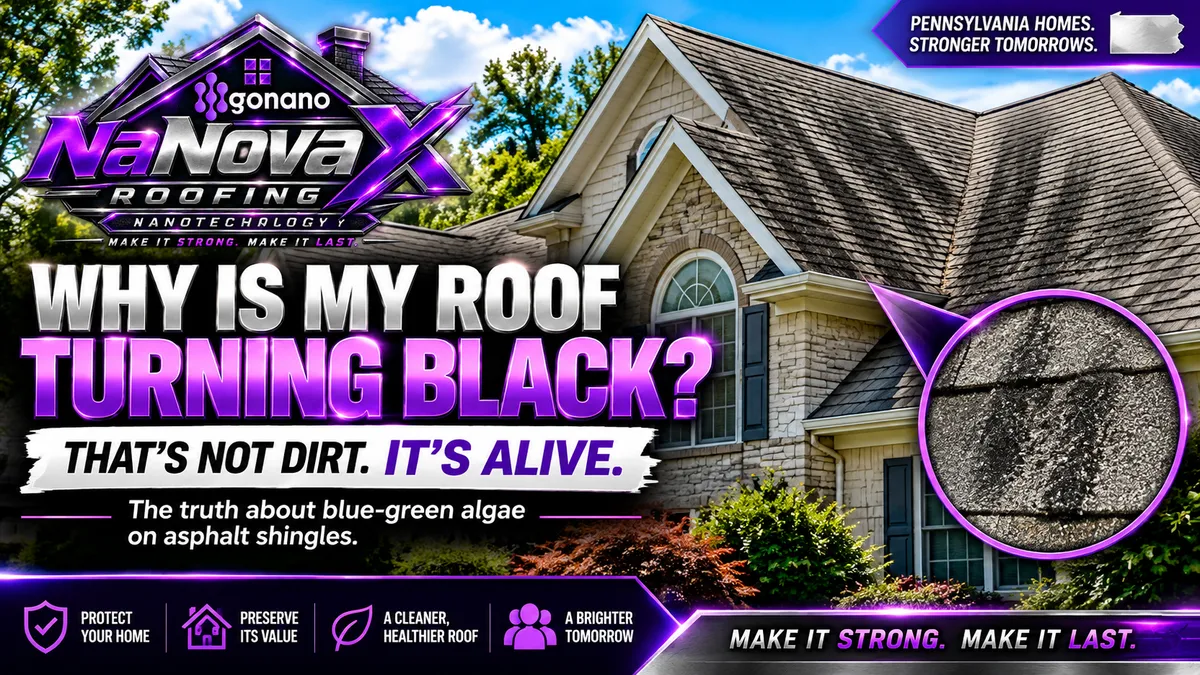
Why Is My Roof Turning Black? Black Streaks, Algae & Moss Explained | NaNova X
WHY DO I HAVE BLACK STREAKS??
THE TRUTH ABOUT BLACK STREAKS, BLUE-GREEN ALGAE, MOSS, FADING & AN OLD-LOOKING ROOF
By NaNova X Roofing Nanotechnology
GoNano Roof Restoration | Pennsylvania
Have you ever looked up at your roof and thought:
“Man... that thing is getting dirty.”
Black streaks.
Dark patches.
Green areas.
Discoloration.
Maybe one entire side of the roof looks worse than the other.
And because the roof looks older, the next thought is usually:
“Great. Am I going to need a new roof?”
Maybe.
But probably not because of the color alone.
Because here's something most homeowners have absolutely no idea about:
THOSE BLACK STREAKS MAY NOT BE DIRT AT ALL.
They may be alive.
--------------------------------------------------
YES.
ALIVE.
--------------------------------------------------
One of the most common causes of black staining on asphalt shingle roofs is an organism called:
GLOEOCAPSA MAGMA.
Most homeowners have never heard that name.
It's commonly called blue-green algae.
Technically, it's a type of cyanobacteria.
And yes...
IT IS A LIVING ORGANISM.
So that nasty-looking black stuff running down your shingles may not be:
Dirt.
Soot.
Pollution.
Or your shingles suddenly turning black.
You may literally have microscopic biological growth living across the surface of your roof.
Welcome to homeownership.
Apparently mowing the grass wasn't enough.
--------------------------------------------------
QUICK ANSWER:
WHY DOES MY ROOF HAVE BLACK STREAKS?
--------------------------------------------------
Black or dark streaks on asphalt shingles are commonly caused by blue-green algae known as Gloeocapsa magma.
The organism thrives in environments where moisture remains available and can spread through airborne particles.
As colonies develop, they form dark pigmentation that creates the black or brown streaking homeowners can see from the ground.
That means:
BLACK STREAKS DO NOT AUTOMATICALLY MEAN YOUR ROOF IS FAILING.
But they do mean we should figure out exactly what we're looking at.
--------------------------------------------------
WAIT.
WHY IS BLUE-GREEN ALGAE BLACK?
--------------------------------------------------
I know.
It sounds ridiculous.
“You're telling me the BLACK stuff is BLUE-GREEN algae?”
Yep.
The organism develops dark pigmentation that helps protect it from sunlight and ultraviolet exposure.
That dark protective covering is largely what you're seeing from the ground.
So the black streak itself isn't necessarily asphalt deterioration.
It can be a biological colony growing across the roofing surface.
That's a huge distinction.
--------------------------------------------------
AND IT CAN SPREAD
--------------------------------------------------
This is another thing homeowners don't realize.
You don't necessarily do something wrong to get roof algae.
The organisms can spread through the air.
Wind can move them.
Animals can contribute to movement.
Environmental conditions can allow colonies to establish on neighboring roofs.
That's why you can drive through a neighborhood and suddenly start noticing:
Black roof.
Black roof.
Black roof.
Clean roof.
Black roof.
It's not because everybody bought the same batch of dirty shingles.
Biological growth can spread where the conditions allow it.
--------------------------------------------------
WHY IS ONE SIDE OF MY ROOF WORSE?
--------------------------------------------------
Now we're getting somewhere.
This is incredibly common.
One slope looks terrible.
The opposite slope looks pretty good.
Same roof.
Same shingles.
Same installation date.
So what happened?
Different environmental conditions.
Sun exposure.
Shade.
Moisture.
Tree cover.
Airflow.
Roof direction.
How quickly the surface dries after rain or morning dew.
North-facing or heavily shaded slopes commonly remain damp longer than sunny areas.
And biological organisms like algae and moss tend to appreciate moisture.
That's why sometimes the ugliest part of the roof is exactly where you'd expect:
The shaded area.
Under the trees.
Behind another roof section.
Or on the side getting less direct sunlight.
--------------------------------------------------
THIS IS WHERE GONANO GETS REALLY INTERESTING
--------------------------------------------------
Remember what GoNano does to asphalt shingles.
One of the major changes created by GoNano nanotechnology is increased HYDROPHOBIC behavior.
Hydrophobic is just the scientific way of saying:
THE MATERIAL BECOMES MUCH MORE RESISTANT TO WATER INFILTRATION.
Instead of water readily interacting with and penetrating the asphalt material, the shingles are designed to repel it more effectively.
You've probably seen the videos.
Rain hits a treated roof.
Water beads.
Water moves.
The shingle stays considerably drier.
And that matters for more than just rain protection.
--------------------------------------------------
WHY?
BECAUSE ALGAE LIKES MOISTURE.
--------------------------------------------------
GoNano itself explains this very simply:
Dry shingles mean fewer damp areas for mold and algae to thrive.
That's an extremely important part of the story.
Think about what biological growth wants.
Moisture.
A favorable surface.
Time.
Shade can help.
Humidity can help.
Damp conditions can help.
So if we change the roofing material so it becomes significantly more hydrophobic and holds far less moisture...
we begin changing the environment that allowed the biological growth to thrive in the first place.
--------------------------------------------------
IN HOMEOWNER LANGUAGE?
WE START CUTTING OFF ITS WATER SUPPLY.
--------------------------------------------------
People sometimes describe this as “starving” the algae.
That's a pretty good way for a homeowner to visualize it — with one clarification:
We're talking primarily about depriving biological growth of the persistent damp environment it prefers.
We're not saying GoNano is some kind of pesticide that poisons algae.
That's not what it is.
GoNano modifies the properties of the asphalt shingle.
The shingle becomes more hydrophobic.
The roof dries differently.
Moisture doesn't remain within the material the same way.
And suddenly the environment becomes much less welcoming to algae and other biological growth.
--------------------------------------------------
GONANO'S OWN SCIENCE MATERIALS ACTUALLY LIST:
“CLEANS AND PREVENTS THE GROWTH OF ALGAE.”
--------------------------------------------------
That's important.
GoNano's current roofing information specifically identifies algae protection as one of the advantages of its molecular-structure modification technology.
It also describes NuRoof Revive as creating a hydrophobic barrier that helps protect against water and algae.
So this isn't something NaNova X just invented for a Facebook post.
It is part of the technology's stated performance.
But there's another distinction homeowners need to understand.
--------------------------------------------------
IF YOU ALREADY HAVE HEAVY ALGAE OR MOSS...
WE MAY NEED TO CLEAN IT FIRST.
--------------------------------------------------
GoNano specifically recommends soft washing BEFORE treatment when there is heavy algae or moss growth rooted into the shingles.
That makes sense.
If you've already got years of biological growth covering the roof, we're not pretending it isn't there.
Clean the roof appropriately.
Remove the established contamination when necessary.
Inspect the shingles underneath.
Repair anything that needs repaired.
Then determine whether the shingles qualify for GoNano roof restoration.
Now we're not simply removing what's growing on the roof.
We're helping change the moisture conditions that made that roof such a comfortable place for biological growth in the first place.
--------------------------------------------------
THAT'S A MUCH BETTER STRATEGY THAN:
CLEAN IT.
WAIT FOR IT TO COME BACK.
CLEAN IT AGAIN.
--------------------------------------------------
And this is one of the reasons GoNano interests me.
Cleaning addresses what's sitting ON the shingles.
GoNano changes properties WITHIN the shingles.
Those are two completely different things.
A soft wash may remove existing staining.
GoNano roof restoration is about changing and protecting the actual roofing material.
That's an important difference.
--------------------------------------------------
BUT IS BLUE-GREEN ALGAE ACTUALLY EATING MY SHINGLES?
--------------------------------------------------
You've probably heard somebody say:
“THAT ALGAE IS EATING YOUR ROOF!”
There is a reason that statement exists.
Some roofing-industry sources describe Gloeocapsa magma as utilizing the limestone filler contained in modern asphalt shingles.
That's where the whole:
“It's eating your shingles”
description came from.
But I want to be accurate here.
The Asphalt Roofing Manufacturers Association has stated that there isn't scientific evidence establishing that blue-green algae itself causes asphalt shingles to fail.
That's important.
So I'm not going to stand in somebody's driveway yelling:
“YOUR HOUSE IS BEING EATEN ALIVE!”
just because it makes the sales pitch scarier.
That's not how NaNova X operates.
--------------------------------------------------
HERE'S WHAT WE DO KNOW.
--------------------------------------------------
The staining can be living biological growth.
It thrives around favorable moisture conditions.
It can make a perfectly serviceable roof look significantly older than it actually is.
Heavy biological growth can complicate the evaluation of the roofing surface.
And moisture conditions matter greatly to the long-term performance of roofing materials.
That is enough reason to take it seriously without inventing something scarier.
--------------------------------------------------
AN UGLY ROOF ISN'T AUTOMATICALLY A BAD ROOF.
--------------------------------------------------
This may be the most important sentence in this article.
A roof covered in black streaks can look terrible from the street.
Your eye sees:
BLACK.
DIRTY.
OLD.
And your brain immediately thinks:
BAD ROOF.
But underneath that staining may be asphalt shingles that remain structurally sound.
Now flip that around.
A roof can also look pretty decent from the driveway...
while underneath we find:
Soft decking.
Bad flashing.
Failed pipe boots.
Moisture.
Poor ventilation.
Improper installation.
Brittle shingles.
Leaks.
That's why appearance matters...
BUT APPEARANCE IS NOT THE DIAGNOSIS.
--------------------------------------------------
THE ROOF IS AN INVESTIGATION.
--------------------------------------------------
If I see black streaks, that's evidence.
If I see green growth, that's evidence.
If I see fading, that's evidence.
Granules in the gutter?
Evidence.
Curling?
Evidence.
Cracking?
Evidence.
Water stains?
Evidence.
Now let's put the evidence together and figure out what is ACTUALLY happening.
--------------------------------------------------
WHAT ABOUT MOSS?
--------------------------------------------------
Moss is different from blue-green algae.
Moss is actual plant growth.
And heavier moss growth gets my attention for another reason:
MOSS HOLDS MOISTURE.
It can create a damp environment directly against the roofing material.
As moss gets thicker, it may also grow around and beneath shingle edges.
That's when something that started as:
“There's green stuff on my roof.”
can become a legitimate roofing concern.
--------------------------------------------------
WHAT ABOUT LICHEN?
--------------------------------------------------
Lichen is another biological growth homeowners commonly mistake for dirt or simple staining.
It may look:
Gray.
Green.
White.
Crusty.
Circular.
Almost like somebody glued little biological pancakes to the shingles.
That's the least scientific description you'll read today.
But once you see them, you'll understand exactly what I mean.
Lichen can attach very strongly to the roofing surface.
And that introduces another problem:
Removing biological growth incorrectly can damage the shingles more than the growth did.
--------------------------------------------------
PLEASE DO NOT PRESSURE WASH ASPHALT SHINGLES.
--------------------------------------------------
I cannot emphasize this enough.
DO NOT BLAST YOUR ASPHALT ROOF WITH A PRESSURE WASHER.
Asphalt shingles have mineral granules embedded into their surface.
Those granules are part of the roofing material's protection.
High-pressure cleaning can remove them.
So yes...
You might get the roof incredibly clean.
You might also be blasting away part of the roof while you're doing it.
That's not exactly a win.
--------------------------------------------------
“BUT IT LOOKS BRAND NEW!”
--------------------------------------------------
Great.
So can wood after you sand half of it off.
The goal isn't simply to make something look clean.
The goal is to clean it without damaging the material we're trying to preserve.
--------------------------------------------------
HOW SHOULD ROOF ALGAE BE CLEANED?
--------------------------------------------------
Follow the shingle manufacturer's recommendations.
That's always where I want to start.
Many situations call for controlled, low-pressure chemical cleaning rather than mechanical blasting.
People commonly call this soft washing.
The important parts are:
Correct chemistry.
Correct dilution.
Low pressure.
Proper technique.
And protecting the roof instead of attacking it.
--------------------------------------------------
DON'T CONFUSE CLEANING WITH RESTORATION.
--------------------------------------------------
This is huge.
A clean roof isn't necessarily a restored roof.
You can wash algae off a 17-year-old asphalt shingle...
and underneath you still have:
A 17-year-old asphalt shingle.
Cleaning addresses the contamination.
It doesn't necessarily address the aging asphalt.
That's where GoNano roof restoration is different.
--------------------------------------------------
CLEANING:
REMOVES WHAT IS ON THE ROOF.
GONANO:
IS DESIGNED TO MODIFY AND PROTECT THE ROOFING MATERIAL ITSELF.
--------------------------------------------------
That's a much easier way for homeowners to understand the difference.
--------------------------------------------------
SO WHERE DOES GONANO FIT AFTER CLEANING?
--------------------------------------------------
Let's say the roof has:
Black streaking.
Some biological growth.
Maybe moss around shaded areas.
But after appropriate cleaning and inspection...
the shingles are still structurally sound.
Now we evaluate the roofing material itself.
How much granule coverage remains?
How brittle are the shingles?
Any cracking?
Any damaged shingles?
How's the decking?
How's the flashing?
Any leaks?
How's the ventilation?
If the roof is still worth preserving...
THAT'S WHERE GONANO ROOF RESTORATION ENTERS THE CONVERSATION.
--------------------------------------------------
GONANO DOES MORE THAN MAKE WATER BEAD.
--------------------------------------------------
Water beading is cool.
It's visual.
Homeowners understand it immediately.
But that's not the only reason the hydrophobic effect matters.
Reducing moisture infiltration can help protect the roofing material from moisture-related environmental stress.
And because biological growth generally thrives in damp environments...
a drier surface can become much less favorable for algae and mold growth.
So now we're accomplishing two things:
PROTECTING THE SHINGLE.
AND MAKING THE ENVIRONMENT LESS FAVORABLE FOR THE STUFF THAT WANTS TO GROW ON IT.
--------------------------------------------------
THAT'S A PRETTY IMPORTANT DIFFERENCE.
--------------------------------------------------
Because instead of only asking:
“How do we clean the black streaks?”
we can ask:
“WHY DOES THIS PART OF THE ROOF KEEP STAYING DAMP ENOUGH FOR THIS STUFF TO THRIVE?”
Now we're investigating the cause instead of only looking at the symptom.
--------------------------------------------------
WHY DOES MY ROOF LOOK FADED?
--------------------------------------------------
Now let's talk about roofs that don't have algae.
Sometimes they just look... tired.
Colors are duller.
One side has faded.
Shingles aren't as rich-looking anymore.
That can involve:
UV exposure.
Weathering.
Different sun exposure.
Granule loss.
Normal aging.
Environmental exposure.
Again:
FADED DOESN'T AUTOMATICALLY MEAN FAILED.
But fading can be one of several clues showing us how the roof is aging.
--------------------------------------------------
WHAT ABOUT BALD SPOTS?
--------------------------------------------------
Different story.
If I'm seeing actual areas where significant granules have disappeared and the underlying asphalt is becoming exposed...
I'm paying attention.
Granules aren't there just to make shingles pretty.
They help protect the asphalt underneath.
This is why homeowners need to understand the difference between:
BLACK ALGAE STAINING
and:
TRUE GRANULE LOSS.
They can look similar from the driveway.
They're very different once we get onto the roof.
--------------------------------------------------
BLACK STREAKS VS. GRANULE LOSS
--------------------------------------------------
Here's the homeowner version:
BLACK STREAKS:
Something is discoloring the surface.
GRANULE LOSS:
Part of the roofing material itself is disappearing.
Very different problem.
Very different diagnosis.
--------------------------------------------------
WHY ARE THERE BLACK STREAKS UNDER MY METAL ROOF VENTS OR FLASHING?
--------------------------------------------------
Here's another interesting one.
Some metals naturally help inhibit algae growth.
That's why homeowners sometimes notice cleaner-looking areas directly underneath certain metal components.
Rainwater passes across the metal and then continues down the roof.
That can sometimes reduce biological growth immediately below those areas.
So you end up with a roof covered in streaking...
except for clean lines underneath metal.
Once you know what you're looking at, you can't unsee it.
--------------------------------------------------
CAN A DIRTY-LOOKING ROOF STILL HAVE YEARS LEFT?
--------------------------------------------------
Absolutely.
Maybe.
Again:
INSPECT IT.
That's the whole point.
An ugly roof can be structurally sound.
A beautiful roof can have problems.
I don't care what it looks like from 50 feet away nearly as much as I care about what the roofing system is actually doing.
--------------------------------------------------
WHEN DOES APPEARANCE BECOME A REAL WARNING SIGN?
--------------------------------------------------
When appearance is combined with other evidence.
For example:
Severe granule loss.
Large-scale cracking.
Significant curling.
Missing shingles.
Soft decking.
Structural sagging.
Widespread water intrusion.
Failed flashing throughout the system.
Now we aren't talking about cosmetic staining anymore.
We're talking about actual roofing-system deterioration.
--------------------------------------------------
CAN BLACK STREAKS ALONE MEAN I NEED A NEW ROOF?
--------------------------------------------------
NO.
Black streaking by itself isn't enough evidence to condemn an asphalt roof.
Clean it appropriately if necessary.
Then inspect the roofing material underneath.
That's the responsible answer.
--------------------------------------------------
IS GONANO A ROOF CLEANER?
--------------------------------------------------
No.
GoNano isn't simply roof bleach.
It isn't a pressure-washing alternative.
It's an asphalt shingle restoration and protection technology.
When heavy algae or moss exists, GoNano recommends appropriate soft washing before application.
Once that preparation is complete and the roof qualifies...
the GoNano treatment can help create the hydrophobic conditions that make the roofing material less hospitable to future biological growth.
--------------------------------------------------
CAN GONANO HELP PREVENT ALGAE FROM COMING BACK?
--------------------------------------------------
This is one of the most interesting benefits.
GoNano specifically identifies algae prevention among the advantages of its technology.
The reason makes sense:
ALGAE AND MOLD THRIVE IN MOIST CONDITIONS.
GoNano makes treated asphalt shingles significantly more hydrophobic.
Less moisture infiltration.
Faster drainage.
Drier roofing material.
Less favorable conditions for algae and mold to thrive.
That's where the “starving the algae” explanation comes from.
We aren't feeding it a poison.
WE'RE MAKING ITS HOME A LOT LESS COMFORTABLE.
--------------------------------------------------
WHAT GONANO CANNOT DO
--------------------------------------------------
GoNano cannot fix:
Rotten decking.
Structural sagging.
Missing roofing material.
Major flashing failures.
Widespread active leaks.
Completely destroyed shingles.
And it doesn't eliminate the need to properly remove heavy established biological growth before treatment when necessary.
That's why the process matters.
--------------------------------------------------
INSPECT.
CLEAN WHEN NECESSARY.
REPAIR.
RESTORE.
PROTECT.
--------------------------------------------------
That's a roofing system.
Not a spray-and-pray sales pitch.
--------------------------------------------------
WHY THIS MATTERS SO MUCH IN PENNSYLVANIA
--------------------------------------------------
Pennsylvania creates plenty of situations where biological growth can thrive.
Humidity.
Rain.
Morning dew.
Tree cover.
Shaded lots.
North-facing roof slopes.
Cool nights.
Older neighborhoods with mature trees.
Then we add:
Snow.
Ice.
Freeze-thaw cycles.
Summer heat.
UV exposure.
Wind.
Hail.
Our roofs have a rough job.
That doesn't automatically mean they're failing.
It means we should understand what we're looking at.
--------------------------------------------------
TRY THIS TOMORROW.
--------------------------------------------------
Walk outside.
Look at your roof.
Now look at the neighbors' roofs.
Do you see black streaks?
Look at the shaded side.
Worse?
Look underneath mature trees.
More growth?
Look at the sunny side.
Cleaner?
Look underneath metal flashing or roof components.
Any cleaner streaks?
You might suddenly realize:
THAT “DIRT” YOU'VE BEEN LOOKING AT FOR YEARS ISN'T DIRT AT ALL.
--------------------------------------------------
HOMEOWNER FAQ
--------------------------------------------------
WHAT CAUSES BLACK STREAKS ON AN ASPHALT ROOF?
A common cause is blue-green algae called Gloeocapsa magma.
IS BLUE-GREEN ALGAE ALIVE?
Yes. It's a living cyanobacterium.
WHY DOES IT LOOK BLACK?
Colonies develop dark pigmentation that creates the black or brown streaks visible on the roof.
DOES ROOF ALGAE LIKE MOISTURE?
Yes. Damp environments help biological growth thrive.
WHY IS ONE SIDE OF MY ROOF WORSE?
Differences in shade, sunlight, roof orientation, tree cover and drying time can create more favorable growing conditions.
DOES THE ALGAE EAT MY ROOF?
Some roofing-industry sources describe the organism as utilizing limestone filler contained in shingles. However, industry guidance does not establish that algae staining by itself means an asphalt shingle is structurally failing.
CAN GONANO HELP WITH ALGAE?
GoNano's current roofing materials identify algae prevention as one of the benefits of the treatment. By making asphalt shingles more hydrophobic, the roof retains less moisture and creates less favorable conditions for algae and mold growth.
DOES GONANO KILL HEAVY EXISTING ALGAE?
Heavy established algae or moss should generally be appropriately soft-washed before GoNano treatment. Afterward, GoNano's hydrophobic protection helps make the roofing material less favorable for future growth.
CAN I PRESSURE WASH MY ASPHALT ROOF?
High-pressure washing is not recommended because it can remove protective granules and damage asphalt shingles.
DO BLACK STREAKS MEAN I NEED A NEW ROOF?
No.
The roof needs to be inspected to determine the condition of the shingles beneath the staining.
WHAT'S THE DIFFERENCE BETWEEN MOSS AND ALGAE?
Blue-green algae is microscopic biological growth that commonly creates staining. Moss is a plant that forms thicker growth and can retain significant moisture against the roofing surface.
CAN A DIRTY-LOOKING ROOF BE RESTORED?
Potentially.
After appropriate cleaning and repairs, a structurally sound asphalt shingle roof may qualify for GoNano roof restoration.
--------------------------------------------------
THE BOTTOM LINE
--------------------------------------------------
One of the biggest mistakes homeowners make is assuming:
UGLY = BAD.
It doesn't.
Black can be algae.
Green can be moss.
Gray can be lichen.
Fading can be weathering.
Dark patches can be granule loss.
And sometimes...
the roof really IS failing.
You can't determine all of that from the driveway.
That's why we inspect.
--------------------------------------------------
DON'T DIAGNOSE YOUR ROOF BY ITS COLOR.
--------------------------------------------------
And don't let somebody else do it either.
If the roof is covered in biological growth...
identify it.
If it needs cleaned...
clean it properly.
If something needs repaired...
repair it.
If the shingles remain structurally sound...
determine whether GoNano roof restoration makes sense.
If the roof has failed...
replace it.
--------------------------------------------------
THIS IS NANOVA X.
--------------------------------------------------
We're not trying to turn every ugly roof into a GoNano sale.
We're not trying to turn every old-looking roof into a $25,000 replacement either.
We're trying to answer one question:
WHAT DOES THIS ROOF ACTUALLY NEED?
Maybe:
CLEAN IT.
Maybe:
REPAIR IT.
Maybe:
RESTORE IT WITH GONANO.
Maybe:
PROTECT IT BEFORE IT AGES FURTHER.
Maybe:
REPLACE IT.
Maybe:
LEAVE IT ALONE.
I can live with every one of those answers.
Because I only care about finding the right one.
THE ROOF IS AN INVESTIGATION.
LOOK CLOSER.
FOLLOW THE EVIDENCE.
INSPECT FIRST.
CLEAN WHEN APPROPRIATE.
REPAIR WHAT NEEDS REPAIRED.
RESTORE WHAT'S WORTH RESTORING.
PROTECT WHAT'S WORTH PROTECTING.
REPLACE WHEN NECESSARY.
AND THE NEXT TIME YOU SEE BLACK STREAKS RUNNING DOWN A ROOF...
REMEMBER:
IT MIGHT NOT BE DIRT.
IT MIGHT BE ALIVE.
NaNova X Roofing Nanotechnology
MAKE IT STRONG.
MAKE IT LAST.