Why Is My Roof Leaking? The Water Stain May Not Be Where the Leak Started | NaNova X
WHY IS MY ROOF LEAKING? THE WATER STAIN MAY NOT BE WHERE THE LEAK STARTED
How Roof Leaks Travel Through a Roofing System — And Why Finding the Entry Point Matters More Than Finding the Stain
By NaNova X Roofing Nanotechnology
GoNano Roof Restoration | Pennsylvania
You walk into a bedroom after a hard rain.
Look up.
And there it is.
A brown spot on the ceiling.
Maybe it's tiny.
Maybe the drywall is bubbling.
Maybe water is actually dripping.
Your first reaction is probably pretty simple:
"THE ROOF MUST BE LEAKING RIGHT ABOVE THAT SPOT."
Maybe.
But don't bet the repair on it.
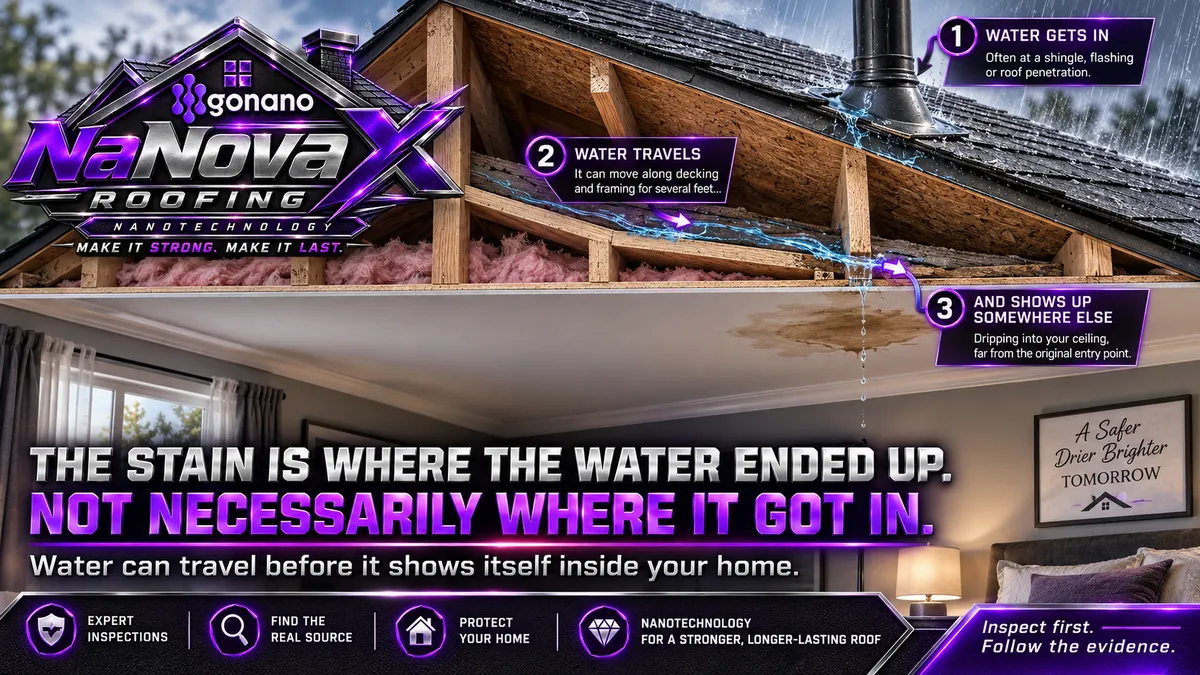
Because one of the biggest mistakes you can make when diagnosing a roof leak is assuming the place where water SHOWED UP is automatically the place where water GOT IN.
THE STAIN TELLS US WHERE THE WATER FINISHED ITS TRIP.
IT DOESN'T NECESSARILY TELL US WHERE THAT TRIP STARTED.
Water can enter a roofing system at one location and move along or through:
ROOF DECKING.
UNDERLAYMENT.
RAFTERS.
TRUSSES.
NAILS.
INSULATION.
FRAMING.
WALL CAVITIES.
OR OTHER BUILDING MATERIALS.
Then gravity finally wins.
The water reaches a low point.
It drips.
The drywall gets wet.
And THAT is the evidence the homeowner sees.
But the actual entry point may be somewhere else.
Sometimes several feet away.
That's why finding a difficult roof leak isn't:
"There's the stain. Patch directly above it."
It's an investigation.
--------------------------------------------------
QUICK ANSWER:
WHY IS MY ROOF LEAKING?
--------------------------------------------------
Common potential roof-leak sources include:
• Damaged or missing shingles
• Deteriorated flashing
• Chimney flashing
• Step flashing
• Pipe boots
• Plumbing penetrations
• Roof vents
• Valleys
• Skylights
• Exposed roofing nails
• Previous repairs
• Failed or improperly used sealant
• Ice dams
• Water backing beneath roofing materials
• Damaged underlayment
• Deteriorated decking
• Wind-driven rain entering vulnerable areas
But there's another important possibility:
THE MOISTURE MAY NOT HAVE COME THROUGH THE ROOF COVERING AT ALL.
Sometimes attic or ceiling moisture can involve:
• Condensation
• Interior humidity
• Bathroom exhaust
• Plumbing
• HVAC equipment
• Ductwork
• Other building-envelope problems
That's why the first job isn't selling a roof.
It's figuring out where the water came from.
--------------------------------------------------
THE CEILING STAIN IS EVIDENCE.
IT IS NOT THE DIAGNOSIS.
--------------------------------------------------
This is the entire article in one sentence.
If I walk into your bedroom and see a ceiling stain, I know something.
MOISTURE WAS THERE.
That's evidence.
But I don't automatically know:
WHY.
I don't know yet whether it came through:
A shingle.
A pipe boot.
Chimney flashing.
A valley.
An exposed fastener.
An ice dam.
Condensation.
Plumbing.
Or something else entirely.
So instead of immediately deciding what happened...
we start asking questions.
WHEN DID YOU FIRST NOTICE IT?
DID IT HAPPEN DURING RAIN?
WAS THE RAIN WIND-DRIVEN?
DOES IT HAPPEN EVERY TIME IT RAINS?
ONLY DURING CERTAIN STORMS?
DOES IT HAPPEN DURING WINTER?
DURING SNOWMELT?
HAS IT HAPPENED WHEN THERE WAS NO RAIN AT ALL?
IS THERE AN ATTIC ABOVE IT?
IS THERE PLUMBING NEARBY?
A BATHROOM?
DUCTWORK?
AN EXHAUST FAN?
WHAT ROOF FEATURES ARE ABOVE OR UPHILL FROM THE AREA?
Now we're investigating.
--------------------------------------------------
HOW CAN A ROOF LEAK SHOW UP SOMEWHERE OTHER THAN WHERE IT STARTED?
--------------------------------------------------
Think about putting a drop of water onto the underside of something that's tilted.
The water doesn't necessarily drop straight down.
It can move.
It can follow a surface.
It can reach another material.
It can hit framing.
Then eventually it finds a place where gravity pulls it down.
Buildings give water plenty of things to follow.
That's why a wet ceiling spot may not sit directly beneath the exterior defect.
The water stain is important.
But it's often just the END of the trail.
Our job is to follow that trail backward.
--------------------------------------------------
DON'T CHASE THE STAIN.
FOLLOW THE EVIDENCE.
--------------------------------------------------
Let's say there's a ceiling stain near a fireplace.
A quick diagnosis might be:
"The roof is leaking above the stain."
But what if the actual entry point is higher up around the chimney?
Water enters around flashing.
Moves down the roof deck.
Follows framing.
Then finally drops near the stain.
If you patch directly above the ceiling mark...
you haven't fixed anything.
You've repaired the wrong location.
And the next hard rain tells you that pretty quickly.
--------------------------------------------------
FLASHING SHOULD BE ONE OF THE FIRST THINGS YOU THINK ABOUT.
--------------------------------------------------
Flashing exists because roofing materials have vulnerable transitions.
Anytime we have:
A CHIMNEY.
A SIDEWALL.
A DORMER.
A SKYLIGHT.
A ROOF PENETRATION.
OR TWO ROOF SURFACES MEETING.
water has to be managed correctly.
GAF identifies damaged or deteriorated flashing as a common roof-leak source and specifically points to vulnerable locations around chimneys, skylights, vents and other penetrations.
SOURCE:
GAF
How to Identify and Repair Roof Leaks
Reference link provided below this article.
--------------------------------------------------
CHIMNEY LEAKS CAN BE TRICKY.
--------------------------------------------------
I've dealt with these personally.
And chimney areas can make leak diagnosis interesting because you've got multiple possible paths for water.
You may have:
STEP FLASHING.
COUNTERFLASHING.
ROOF-TO-CHIMNEY TRANSITIONS.
MORTAR.
CRACKS.
SEALANTS FROM OLD REPAIRS.
DECKING.
AND WATER MOVING AROUND THE CHIMNEY STRUCTURE ITSELF.
So when somebody tells me:
"My ceiling is wet beside the fireplace."
I'm not interested in throwing roof cement at the first thing I see.
I want to know:
WHERE IS WATER ACTUALLY GETTING IN?
--------------------------------------------------
PIPE BOOTS ARE ANOTHER BIG ONE.
--------------------------------------------------
Every time you put a hole through a roofing system, you have to manage water around that penetration.
Plumbing vent pipes commonly extend through residential roofs.
The pipe itself isn't necessarily the problem.
The vulnerable area is where that pipe passes through the roofing system.
That's why pipe-boot flashing exists.
GAF identifies plumbing vent penetrations as common roof-leak locations and emphasizes proper flashing around them.
Over time, depending on the boot and materials involved, you may find:
CRACKED RUBBER.
DETERIORATION.
FAILED PREVIOUS REPAIRS.
FLASHING PROBLEMS.
IMPROPER INSTALLATION.
OR OTHER DAMAGE.
SOURCE:
GAF
Using Pipe Boot Flashing for a Roof Leak Repair
Reference link provided below.
--------------------------------------------------
THIS IS WHY OUR PREVIOUS ARTICLE ABOUT EXPOSED NAILS MATTERS.
--------------------------------------------------
An exposed roofing nail can look insignificant.
One little piece of metal.
But GAF warns that exposed fasteners can create opportunities for water infiltration.
And again...
if water gets through around that fastener, where it eventually becomes visible inside the house may not perfectly identify where it entered.
That's why:
THE NAIL ISN'T THE ANSWER.
IT'S EVIDENCE.
--------------------------------------------------
VALLEYS DESERVE ATTENTION.
--------------------------------------------------
Look at what a roof valley does during heavy rain.
Water from TWO roof planes is being directed toward the same channel.
That's a lot of water movement through one area of the roofing system.
If something in that valley isn't right...
the amount of water moving through the area can expose the weakness quickly.
Potential concerns can involve:
DAMAGED MATERIALS.
INSTALLATION ISSUES.
FLASHING CONDITIONS.
DEBRIS.
PREVIOUS REPAIRS.
OR WATER FINDING A PATH BENEATH THE ROOFING MATERIALS.
Again:
DON'T JUST LOOK AT THE STAIN.
Look at the roof geometry above it.
--------------------------------------------------
WHAT ABOUT SHINGLES?
--------------------------------------------------
Absolutely.
Sometimes the shingles ARE the problem.
We may find:
MISSING SHINGLES.
BROKEN SHINGLES.
CRACKED SHINGLES.
WIND-DAMAGED SHINGLES.
IMPROPERLY INSTALLED SHINGLES.
OLD DAMAGE.
OR A REPAIR THAT FAILED.
But here's where I don't want homeowners getting sold too quickly.
One damaged shingle doesn't automatically mean:
NEW ROOF.
You determine the extent of the damage.
You inspect the rest of the roofing system.
And then you decide whether you're looking at:
A REPAIR.
A LARGER ROOFING PROBLEM.
OR A FAILED ROOF.
--------------------------------------------------
WHAT ABOUT ROOF CEMENT AND CAULK?
--------------------------------------------------
Sealants have legitimate roofing uses when the application and material are appropriate.
But there's something I absolutely hate seeing.
A leak happens.
Somebody gets on the roof.
And suddenly everything within ten feet looks like it was attacked with a bucket of black roof cement.
That isn't leak diagnosis.
Sometimes it temporarily stops water.
Sometimes it doesn't.
Sometimes it hides the evidence you actually needed to understand the problem.
My question remains:
WHY WAS WATER GETTING IN?
Fix THAT.
--------------------------------------------------
WHAT IF MY ROOF ONLY LEAKS WHEN THE WIND BLOWS HARD?
--------------------------------------------------
That's useful evidence.
If water only appears during certain storms, the storm conditions matter.
Direction matters.
Wind matters.
How water is being driven across the roof matters.
Now I want to examine:
FLASHING.
SIDEWALLS.
CHIMNEY AREAS.
PENETRATIONS.
SHINGLES.
VALLEYS.
ROOF-TO-WALL CONNECTIONS.
AND OTHER VULNERABLE TRANSITIONS.
A leak that happens during every gentle rain can tell one story.
A leak that appears only during a hard wind-driven storm may tell another.
CONDITIONS ARE EVIDENCE.
--------------------------------------------------
PENNSYLVANIA ADDS ANOTHER PROBLEM:
ICE DAMS.
--------------------------------------------------
Pennsylvania roofs don't just deal with rain.
We deal with:
SNOW.
FREEZING TEMPERATURES.
THAWING.
REFREEZING.
AND ICE.
An ice dam can form along colder roof edges while snowmelt continues above it.
Water can then back up beneath roofing materials instead of draining normally off the roof.
The U.S. Department of Energy identifies heat transfer, insulation and attic/roof conditions as important pieces of the ice-dam problem.
GAF also identifies ice dams as a potential cause of roof leakage.
So if somebody tells me:
"My roof only leaks when snow is melting."
That's important.
That's evidence.
It doesn't automatically mean:
BAD SHINGLES.
We need to understand the entire system.
SOURCE:
U.S. Department of Energy
Building Science Education — Cold Climate Eaves / Ice Dams
Reference link provided below.
SOURCE:
GAF
How to Identify and Repair Roof Leaks
Reference link provided below.
--------------------------------------------------
WHAT IF THERE'S MOISTURE IN THE ATTIC BUT THE ROOF ISN'T LEAKING?
--------------------------------------------------
Now things get interesting.
Because:
WATER IN THE ATTIC DOESN'T AUTOMATICALLY MEAN WATER CAME THROUGH THE SHINGLES.
Remember our attic-ventilation article.
Interior moisture can sometimes reach an attic.
Warm humid air can interact with cold surfaces.
Condensation can occur.
Bathroom exhaust can create problems if moisture is improperly dumped into attic space.
Other mechanical or plumbing sources may also be involved.
That's why seeing wet roof decking from inside doesn't automatically give me permission to blame the roofing materials.
Find the source.
--------------------------------------------------
THIS IS WHY AN ATTIC INSPECTION CAN BE SO IMPORTANT.
--------------------------------------------------
Sometimes the best evidence isn't on top of the roof.
It's underneath it.
If attic access is possible and safe, I may want to inspect:
THE UNDERSIDE OF THE ROOF DECK.
RAFTERS.
TRUSSES.
INSULATION.
NAIL PENETRATIONS.
PLUMBING PENETRATIONS.
CHIMNEY AREAS.
VENTILATION.
WATER STAINING.
MOISTURE PATTERNS.
DARKENED WOOD.
ACTIVE DRIPPING.
OLD WATER MARKS.
PREVIOUS REPAIRS.
Because now I can compare what's happening outside with what's happening inside.
A ROOF HAS TWO SIDES.
LOOK AT BOTH.
--------------------------------------------------
AND THIS IS WHERE THERMAL IMAGING CAN BECOME ANOTHER TOOL.
--------------------------------------------------
Thermal imaging can be extremely useful during certain moisture investigations.
But let's explain what it actually does.
Because there is a lot of garbage marketing around thermal cameras.
THERMAL IMAGING DOES NOT MAGICALLY SEE WATER THROUGH YOUR CEILING.
A thermal camera detects differences in apparent surface temperature.
That's what it's showing us.
Under the right conditions, moisture, evaporation, wet insulation and differences in thermal behavior may create temperature patterns that stand out from surrounding dry materials.
That can give us another place to investigate.
FLIR describes its infrared-guided moisture tools as using thermal imaging to identify temperature differences and guide the inspector toward areas requiring further moisture investigation.
That's exactly how I look at it.
SOURCE:
FLIR
Infrared Guided Measurement Technology
Reference link provided below.
--------------------------------------------------
THE CAMERA DOESN'T MAKE THE DIAGNOSIS.
IT HELPS THE INVESTIGATION.
--------------------------------------------------
That distinction matters.
Let's say I've got a ceiling stain.
I scan the area with thermal imaging.
And there's an abnormal temperature pattern extending farther across the ceiling than what I can see with my eyes.
Interesting.
That's evidence.
Maybe I follow that pattern.
Maybe I inspect the attic above it.
Maybe I look at the insulation.
Maybe I compare it with exterior roof features.
Maybe I use a moisture meter.
Now I'm building the story.
But I'm NOT going to point at a purple spot on a thermal camera and announce:
"THERE'S YOUR ROOF LEAK."
Not that fast.
I want corroborating evidence.
--------------------------------------------------
THE WATER STAIN TELLS US WHERE MOISTURE SHOWED UP.
THERMAL IMAGING MAY HELP US UNDERSTAND WHERE TO INVESTIGATE NEXT.
--------------------------------------------------
That's how thermal imaging should be used.
As another tool.
Not THE tool.
And conditions matter.
Infrared results can be influenced by:
TEMPERATURE DIFFERENCES.
SUN EXPOSURE.
WIND.
ROOFING MATERIALS.
INSULATION.
HVAC.
TIME OF DAY.
AND WHETHER THE MATERIAL IS STILL WET.
InterNACHI's guidance on infrared roof inspection specifically notes that roof construction and weather conditions affect how useful thermal imaging can be.
SOURCE:
InterNACHI
IR Cameras: Inspecting Roofs
Reference link provided below.
--------------------------------------------------
THERMAL IMAGING + MOISTURE METER = BETTER EVIDENCE.
--------------------------------------------------
Here's another important distinction.
A thermal camera measures temperature patterns.
A moisture meter helps investigate whether moisture is actually present in a material.
Those aren't the same measurement.
That's why thermal imaging can help guide the investigation...
and then a moisture meter can be used when appropriate to help verify suspected wet areas.
InterNACHI specifically recommends further investigation and moisture-meter verification of suspected areas identified through infrared imaging.
FLIR also combines thermal imaging and direct moisture measurement in professional moisture-inspection equipment for exactly this reason.
SOURCE:
InterNACHI
IR Cameras: Inspecting Roofs
SOURCE:
FLIR
MR265 Moisture Meter and Thermal Imager
Reference links provided below.
--------------------------------------------------
THIS IS WHAT A REAL LEAK INVESTIGATION CAN LOOK LIKE.
--------------------------------------------------
Not every leak requires every one of these steps.
But depending on the situation, we may use:
HOMEOWNER INTERVIEW
↓
VISUAL CEILING INSPECTION
↓
THERMAL IMAGING
↓
MOISTURE METER
↓
ATTIC INSPECTION
↓
EXTERIOR ROOF INSPECTION
↓
FLASHING / PENETRATION INSPECTION
↓
FOLLOW THE MOISTURE PATTERN
↓
IDENTIFY THE MOST LIKELY ENTRY POINT
↓
REPAIR
↓
VERIFY
That's very different from:
"There's a stain.
You need a roof."
--------------------------------------------------
STEP 1:
LISTEN TO THE HOMEOWNER.
--------------------------------------------------
People underestimate this.
The homeowner has been living with the house.
Ask questions.
WHEN DOES IT LEAK?
WHEN DID IT START?
WHAT WAS THE WEATHER?
HAS ANY ROOF WORK BEEN DONE?
ANY CHIMNEY WORK?
NEW HVAC?
NEW BATHROOM FAN?
PLUMBING WORK?
WAS THERE A STORM?
WERE SHINGLES REPAIRED?
HAS SOMEBODY ALREADY TRIED TO FIX IT?
Sometimes the homeowner gives you the first major piece of evidence before you even touch the roof.
--------------------------------------------------
STEP 2:
LOOK AT WHERE THE WATER SHOWED UP.
--------------------------------------------------
What's the pattern?
One spot?
A straight line?
A large diffuse area?
A drip?
Multiple stains?
Near an exterior wall?
Near a chimney?
Near a bathroom?
Near an HVAC component?
Again...
EVIDENCE.
--------------------------------------------------
STEP 3:
USE THERMAL IMAGING WHEN IT ADDS VALUE.
--------------------------------------------------
Not because carrying a thermal camera looks impressive.
Because sometimes it lets us see a temperature pattern our eyes cannot.
And that can help determine where the investigation should go next.
THERMAL IMAGING IS AN ALTERNATIVE DIAGNOSTIC TOOL.
It's another way to gather evidence.
--------------------------------------------------
STEP 4:
VERIFY MOISTURE WHEN APPROPRIATE.
--------------------------------------------------
A suspicious thermal pattern isn't enough by itself.
If conditions allow, moisture measurements can help confirm whether a material is actually wet.
Now the evidence is getting stronger.
--------------------------------------------------
STEP 5:
GET INTO THE ATTIC WHEN IT MAKES SENSE.
--------------------------------------------------
This can completely change the investigation.
Maybe we find:
A WATER TRAIL.
A STAINED RAFTER.
A DARKENED ROOF DECK.
WET INSULATION.
A NAIL WITH A WATER TRAIL.
A PIPE PENETRATION.
A CHIMNEY CONNECTION.
CONDENSATION.
AN EXHAUST PROBLEM.
OR ABSOLUTELY NOTHING OBVIOUS.
Every result tells us something.
--------------------------------------------------
STEP 6:
INSPECT THE ROOF.
--------------------------------------------------
Now I'm comparing the exterior roof with what I found inside.
What's uphill from the moisture?
Chimney?
Valley?
Pipe boot?
Wall?
Vent?
Exposed fastener?
Previous repair?
Damaged shingles?
Skylight?
Ice-dam area?
We're connecting the evidence.
--------------------------------------------------
STEP 7:
DON'T STOP UNTIL THE EXPLANATION MAKES SENSE.
--------------------------------------------------
This matters.
I've been on leak calls where the first suspected location wasn't the actual answer.
That happens.
Leak diagnosis can be difficult.
Sometimes you repair something that legitimately looks questionable and the problem still exists.
Then you keep investigating.
You don't just pretend the leak is fixed because you sent an invoice.
FOLLOW THE EVIDENCE UNTIL THE STORY MAKES SENSE.
--------------------------------------------------
WHAT IF THERMAL IMAGING SHOWS NOTHING?
--------------------------------------------------
That doesn't automatically mean:
NO LEAK.
Remember what the camera measures.
TEMPERATURE DIFFERENCES.
If the material is dry at the time of inspection...
if environmental conditions don't create enough thermal contrast...
if insulation or building materials affect the pattern...
the camera may not give you the smoking gun you're hoping for.
That's why I don't build the entire diagnosis around one piece of equipment.
The camera is a tool.
So is the moisture meter.
So is the attic.
So are my eyes.
So is the homeowner's description.
Put the evidence together.
--------------------------------------------------
CAN A ROOF LEAK BE DIFFICULT TO FIND?
--------------------------------------------------
Hell yes.
Some are easy.
You walk into the attic during rain and there's water dripping around a cracked pipe boot.
There's your problem.
Others make you work.
Intermittent leaks.
Wind-driven leaks.
Chimney leaks.
Leaks that only happen during snowmelt.
Water traveling before it drops.
Old repairs hiding original defects.
Those require investigation.
And sometimes more than one visit.
--------------------------------------------------
THIS IS WHY I'M CAREFUL WITH THE WORD "LEAK."
--------------------------------------------------
If I see moisture...
I have confirmed moisture.
I haven't necessarily confirmed the source.
That's an important difference.
Because homeowners spend real money based on what we're telling them.
If I diagnose the wrong thing, somebody pays to repair something that may never have been broken.
That's unacceptable.
--------------------------------------------------
DOES A ROOF LEAK MEAN I NEED A NEW ROOF?
--------------------------------------------------
NO.
Not automatically.
This is one of the biggest reasons this article exists.
Imagine you've got an otherwise healthy asphalt-shingle roof and one failed pipe boot.
Would it make sense to replace the entire roof solely because that repairable component leaked?
Not necessarily.
Now change the situation.
Multiple active leaks.
Widespread shingle failure.
Soft or rotted decking.
Structural damage.
Major installation defects.
Completely deteriorated roofing system.
That's a different conversation.
THE EXTENT AND CAUSE OF THE LEAK MATTER.
--------------------------------------------------
REPAIR OR REPLACE?
--------------------------------------------------
That's the real decision.
A localized problem may be repairable.
A failed system may not be.
The inspection should help determine which one you're actually dealing with.
We don't want to repair something that legitimately needs replaced.
But we also don't want to replace 2,000 square feet of functioning roofing because five square feet needed repaired.
THE ROOF GETS THE FINAL VOTE.
--------------------------------------------------
CAN GONANO FIX A ROOF LEAK?
--------------------------------------------------
NO.
And that needs to be extremely clear.
GoNano Structural Roof Rejuvenation is NOT a roof-leak repair.
It isn't:
FLASHING.
A PIPE BOOT.
PLYWOOD.
OSB.
A SHINGLE PATCH.
ROOF CEMENT.
OR A STRUCTURAL REPAIR.
GoNano's current candidate guidance specifically says active widespread leaks generally disqualify a roof from rejuvenation.
It also says isolated repairable issues can sometimes be addressed FIRST.
SOURCE:
GoNano
Is Your Roof a Candidate for Roof Rejuvenation?
Reference link provided below.
--------------------------------------------------
REPAIR FIRST.
RESTORATION SECOND.
--------------------------------------------------
That's the NaNova X approach.
If I find an active leak...
I want the leak diagnosed.
I want the cause repaired.
Then I want to know:
IS THE DECKING SOUND?
IS THE STRUCTURE SOUND?
WHAT CONDITION ARE THE SHINGLES IN?
WAS THE DAMAGE LOCALIZED?
IS THE REMAINING ASPHALT ROOF STILL WORTH PRESERVING?
Now we can talk about restoration.
--------------------------------------------------
WHERE DOES GONANO ROOF RESTORATION FIT?
--------------------------------------------------
GoNano Structural Roof Rejuvenation is designed for qualifying asphalt-shingle roofs that are aging but still structurally sound.
GoNano describes the system as restoring aging asphalt shingles from within by replenishing depleted oils and adding nanotechnology reinforcement.
But GoNano itself makes the distinction:
IT IS NOT A REPAIR FOR AN ACTIVE LEAK OR A FAILED ROOF.
SOURCE:
GoNano
What Is Structural Roof Rejuvenation?
Reference link provided below.
--------------------------------------------------
THIS IS WHY WE DON'T SPRAY EVERY ROOF.
--------------------------------------------------
Think about how backwards this would be.
Roof is leaking.
Decking is wet.
Pipe boot is destroyed.
Flashing is failing.
And somebody says:
"Don't worry. We'll spray GoNano on it."
NO.
Find the leak.
Repair the leak.
Evaluate any damage.
Make sure the roofing system qualifies.
THEN decide whether GoNano roof restoration makes sense.
WE DON'T MAKE THE ROOF FIT THE PRODUCT.
--------------------------------------------------
WHAT IF THE LEAK WAS REPAIRED AND THE REST OF THE ROOF IS GOOD?
--------------------------------------------------
Now we're talking.
Maybe the problem was isolated.
Maybe the roof still has years of useful structural life.
Maybe the shingles are aging but still viable.
Maybe that's exactly when preservation deserves consideration.
That's the difference between:
FAILED ROOF
and
REPAIRABLE ROOF.
Don't confuse the two.
--------------------------------------------------
THE LEAK MAY ACTUALLY HELP US MAKE A BETTER DECISION.
--------------------------------------------------
I know that sounds strange.
But think about it.
The leak forces us to investigate.
While we're investigating, we learn about:
THE DECKING.
THE SHINGLES.
THE ATTIC.
THE VENTILATION.
THE FLASHING.
THE PENETRATIONS.
THE INSTALLATION.
THE CONDITION OF THE ENTIRE SYSTEM.
Now instead of guessing how healthy the roof is...
we actually know more about it.
That's valuable.
--------------------------------------------------
WHAT SHOULD PENNSYLVANIA HOMEOWNERS DO WHEN THEY FIND A CEILING STAIN?
--------------------------------------------------
First:
Don't panic.
Second:
Don't ignore it.
Document when you first saw it.
Take pictures.
Think about the weather conditions when it appeared.
If water is actively entering near electrical fixtures or creating another immediate safety concern, avoid the affected area and get appropriate professional help.
Then have the source investigated.
And don't let somebody convince you they know the cause without actually investigating the evidence.
--------------------------------------------------
HOMEOWNER FAQ
--------------------------------------------------
WHY IS MY ROOF LEAKING?
Common causes include damaged shingles, flashing problems, pipe boots, roof penetrations, valleys, skylights, exposed fasteners, ice dams and other roofing defects.
But moisture can also come from non-roof sources, which is why inspection matters.
DOES A CEILING STAIN SHOW EXACTLY WHERE MY ROOF IS LEAKING?
Not necessarily.
The stain shows where moisture became visible.
Water can move through or along building materials before it reaches the ceiling.
CAN WATER TRAVEL FROM A ROOF LEAK?
Yes.
Water may follow decking, framing or other materials before eventually dripping somewhere else.
CAN THERMAL IMAGING FIND A ROOF LEAK?
Thermal imaging can HELP investigate moisture problems under the right conditions.
It detects apparent surface-temperature differences that may indicate areas requiring further investigation.
It does not directly see water through a wall or automatically prove the source of a leak.
WHAT DOES A THERMAL CAMERA ACTUALLY SHOW?
Temperature differences.
Moisture and wet materials can sometimes create thermal patterns that differ from surrounding dry materials.
Those patterns can help guide the inspection.
SHOULD A MOISTURE METER BE USED WITH THERMAL IMAGING?
It can be extremely useful.
Thermal imaging may identify a suspicious area, while moisture measurements can help verify whether moisture is actually present.
CAN THERMAL IMAGING MISS A LEAK?
Yes.
Weather, temperature differences, materials, insulation, timing and whether the affected area is currently wet can all influence thermal imaging results.
That's why thermal imaging should be used as part of an investigation rather than as the only diagnostic method.
WHY DOES MY ROOF ONLY LEAK DURING HARD RAIN?
Wind direction and storm intensity can change how water interacts with flashing, penetrations, roof-to-wall intersections and damaged roofing materials.
That pattern is useful information for the investigation.
WHY DOES MY ROOF ONLY LEAK WHEN SNOW MELTS?
Ice dams and snowmelt can create water conditions very different from ordinary rainfall.
Pennsylvania homeowners should consider attic insulation, air leakage, roof temperature and ice-dam conditions as part of the investigation.
CAN A PIPE BOOT CAUSE A ROOF LEAK?
Yes.
Pipe penetrations and their flashing systems are common areas to inspect during roof-leak diagnosis.
CAN CHIMNEY FLASHING CAUSE A LEAK?
Yes.
Chimneys are complex roof transitions and damaged or improperly installed flashing can allow water intrusion.
DOES WATER IN MY ATTIC AUTOMATICALLY MEAN MY ROOF IS LEAKING?
No.
Roof leakage is one possibility.
Condensation, interior humidity, bathroom exhaust, plumbing and other moisture sources can also be involved.
DO I NEED A NEW ROOF IF I HAVE A LEAK?
Not automatically.
A localized repairable leak is very different from widespread roofing failure.
The cause and extent of damage should determine whether repair or replacement makes sense.
CAN GONANO STOP AN ACTIVE ROOF LEAK?
GoNano Structural Roof Rejuvenation is not an active roof-leak repair.
Necessary leak repairs should be completed first.
CAN GONANO BE APPLIED AFTER A ROOF LEAK IS REPAIRED?
Potentially.
If the leak has been properly addressed and the remaining asphalt-shingle roofing system is structurally sound and otherwise qualifies, GoNano roof restoration may be an option.
HOW DO I KNOW IF MY ROOF IS WORTH SAVING?
Inspect it.
Look at the condition of the shingles, decking, flashing, penetrations, attic and overall roofing system.
Condition matters more than one symptom alone.
--------------------------------------------------
THE BIGGEST THING I WANT HOMEOWNERS TO REMEMBER
--------------------------------------------------
If there's a brown stain on your ceiling...
don't immediately ask:
"HOW MUCH IS A NEW ROOF?"
Ask:
"WHERE DID THE WATER COME FROM?"
That's the question that matters.
The stain isn't necessarily the beginning.
It may be the END of the story.
And our job is to read the evidence backward until we find where the story started.
--------------------------------------------------
THE NANOVA X APPROACH
--------------------------------------------------
WE DON'T CHASE STAINS.
WE FOLLOW EVIDENCE.
VISUAL INSPECTION.
ATTIC INSPECTION.
THERMAL IMAGING WHEN USEFUL.
MOISTURE TESTING WHEN APPROPRIATE.
ROOF INSPECTION.
FLASHING.
PENETRATIONS.
DECKING.
SHINGLES.
WEATHER HISTORY.
HOMEOWNER HISTORY.
Use every useful piece of evidence available.
Then make the decision.
Maybe the answer is:
A SMALL REPAIR.
Maybe it's:
FLASHING.
Maybe it's:
A PIPE BOOT.
Maybe it's:
ATTIC MOISTURE.
Maybe it's:
DECKING REPAIR.
Maybe it's:
A ROOF REPLACEMENT.
Maybe after the necessary repairs it's:
GONANO ROOF RESTORATION.
And sometimes...
maybe the roof doesn't need anything else at all.
DON'T MAKE THE ROOF FIT THE PRODUCT.
THE WATER STAIN ISN'T THE ANSWER.
IT'S EVIDENCE.
A ROOF LEAK ISN'T JUST A LOCATION.
IT'S AN INVESTIGATION.
THE SALE ISN'T THE FIRST STEP.
THE INVESTIGATION IS.
REPAIR WHAT NEEDS REPAIRED.
RESTORE WHAT'S WORTH SAVING.
THE ROOF GETS THE FINAL VOTE.
NaNova X Roofing Nanotechnology
Pennsylvania
MAKE IT STRONG.
MAKE IT LAST.